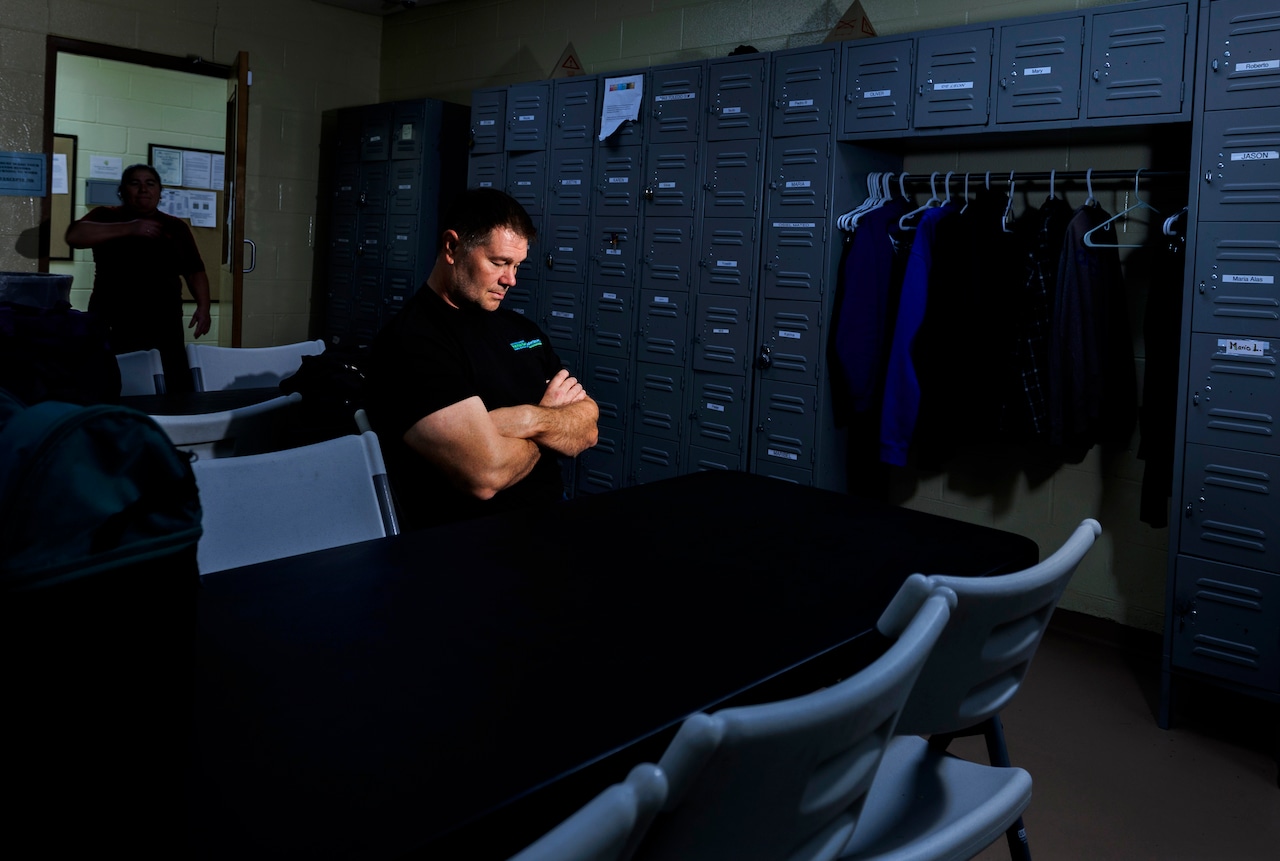
Cato, N.Y. – Sheriff’s deputies stopped Lenny Schmidt in the driveway of his family’s protein bar factory. Federal agents and deputies swarmed the parking lot. They ordered him to stay put and blocked his path.
Then an immigration agent came up to his truck and told him they had a warrant for a violent felon, Schmidt said. If they could find him, they’d be out of there fast, Schmidt said the agent told him.
“We don’t want those kinds of people here,” Schmidt said he told the agent. “Please, do your thing. Please get them out as soon as possible.”
Schmidt and his brother, Jeff, sat in the truck for three hours.
The raid ended with a surprise. Schmidt watched as 69 people, all of them Latino, were herded from the building. Many of them were deported to Guatemala less than 72 hours later. Some are being held in Texas. A breastfeeding mother is being held in a Border Patrol station in Wellesley Island, away from her infant. Another mother is in Louisiana.
There was no dangerous felon.
The raid of Nutrition Bar Confectioners Sept. 4 turned up five arrests of people who entered the U.S. illegally after previously being deported. No one has been charged with any other crime.
Syracuse.com spoke with at least 25 people — the workers, their families and advocates, the factory owners and several immigration lawyers — to piece together the raid and the aftermath, and to review the conduct of the federal agents.
The interviews depict a raid that was aimed at swiftly moving people out of the country in big numbers, ultimately raising questions that the workers were denied due process and constitutional protections.
Several aspects of the raid and the treatment of the detainees appear to be in violation of the law, lawyers said.
Among their criticisms:
Workers were sorted by race. Latino workers stayed; white workers could go. The practice, until recently, has been viewed traditionally as a civil rights violation.
At least one person detained had legal government permission to work and a pending immigration case. He should not have been detained, according to a lawyer with the New York Civil Liberties Union. Still, he was deported less than 72 hours later. Other workers and lawyers said those detained also had documents that should have prevented them from being taken.
The type of search warrant used to get into the factory was an administrative warrant, intended for lesser cases. It wasn’t a criminal search warrant.
Workers taken into custody were kept from their families and lawyers to make it tougher for them to press any legal defenses, lawyers told syracuse.com.
The federal officials emphasized secrecy. The agents wore masks. The request for the search warrant is sealed from the public. Information about detainees was kept out of a national tracking computer system. The agencies have refused to answer questions about their conduct.
“It’s hard to keep track of ICE’s lawlessness,” said Amy Belsher, an immigration attorney with the New York Civil Liberties Union.
Longtime immigration lawyers said they’d seen nothing like this before. Their clients were shuffled quickly from one Border Patrol station to another before anyone could find them, and sometimes then swiftly out of the country.
“People are disappeared,” Belsher said.
Most were not allowed to speak with lawyers before they were deported; some never spoke with relatives either, or for just a minute. This treatment creates pressure for them to agree to self-deportation, lawyers said, and puts the detainees in a black hole without accountability.
It was like they were kidnapped, attorneys and family said.
Syracuse.com contacted all of the federal agencies involved in the raid to ask them about these practices. None of them answered questions.
In Guatemala in a hurry
Hediberto Perez-Ramirez, 46, is one of the workers deported to Guatemala. He spoke to syracuse.com from that country.
He said he slept on a mat on the floor in three different Border Patrol stations. He said he asked to speak to his lawyer several times at every stop. He was not allowed to call anyone and given only cheese crackers to eat, he said.
On the third day, when he was flown with other detainees from Buffalo to the Border Patrol Station in McAllen, Tex., he was finally allowed to call his wife, he said. He told her he was in Texas and to call the lawyer.
He said he told authorities there that he had an immigration appeal pending. He said one person told him he could talk to his lawyer on Monday. But late Saturday night, Perez-Ramirez said, agents told him he was being deported to Guatemala.
At a news conference this week, Acting U.S. Attorney John A. Sarcone III said all of the deported workers waived their legal rights to due process here.
Perez-Ramirez said this is not true. “I didn’t sign anything,” he said in an interview from Guatemala.
He said he was not allowed to appear before a judge or to call his lawyer. He wasn’t even able to call his wife and tell her and his teen sons that he was leaving the country.
“That’s insane. That’s really egregious. Really, really egregious,” said Belsher, the NYCLU lawyer. She said the deportation was illegal. Perez-Ramirez should have been able to call his lawyer, to appear before a judge, and consent, on paper, to his deportation.
Perez-Ramirez said he and some others were put in shackles on both their hands and feet. Then they were put on a plane to Guatemala. Agents took away his paperwork, including his work permit and his New York driver’s license, he claimed.
He said as they walked to the plane in shackles, he told the agents, “We are not criminals.”
Sorted by skin color
Elizabeth Abrams-Perez, Hediberto’s wife, also was working during the raid. She and others said the agents racially profiled them. Anyone who looked Latino was sent to the breakroom. She and the other white people were told to leave, she said.
Witnesses described chaos. Agents streamed in through the side doors they had pried open. They swarmed the hallways, ran into bathrooms. Sylvia Valacios was on the toilet with her pants down when a male agent burst in and barked at her to follow him, she told syracuse.com.
In the breakroom, the Latino workers were asked to show paperwork. The Spanish-speaking agents wore masks, said workers and factory owners. They yelled at the workers. Some were shoved. One was hit in the back of the head, factory owners and a worker said.
Workers said they showed the agents their work permits, or phone pictures of the documents. If you are not a citizen of the U.S., you can get a permit from the U.S. government to work legally. This usually means you have some sort of proceeding in immigration court in which you are asking to be allowed to stay. These cases can take years.
But agents told the workers the permits were not enough, said workers, advocates and lawyers; they had to prove they were in the country legally. Many had pending immigration cases in which they could have been granted legal status. They should not have been detained, lawyers said. But many were detained.
Video taken by Valacios in the breakroom (below) shows agents deciding who should stay and who should go.
Valacios said she showed the agent a copy of her work permit. She said the agent told her: That doesn’t count. She frantically messaged her lawyer, Desiree Lurf, who sent her back a copy of her pending immigration case.
“Then they said, ‘OK, you can go,’ ” Valacios said the agent told her. Many of the other workers who had immigration lawyers showed agents their paperwork, too. It worked for some. Of the original 69 detained, 57 are either still in custody or have already been deported.
An unconventional search warrant
Outside the factory, Schmidt was in his truck with one of his brothers. He was nervous for his workers, he said, because he was told someone dangerous was inside.
Corinne Price, his wife, said some employees inside were also told by agents that they were looking for someone dangerous. At one point, agents said they were looking for two people from Florida.
“It was very specific,” Price said.
But when all of the Latino workers were loaded into vans, Schmidt realized this was something else.
His family received the warrant after the search was done. When they read it, they were even more puzzled.
There are no specific people mentioned anywhere in the warrant. A cover sheet says the agents were allowed to search for “aliens present unlawfully in the United States and for the purpose of taking such actions, with respect to any such aliens present there, as are authorized by law,” according to a copy of the warrant obtained by syracuse.com.
The warrant also authorized agents to take all of the business’s records and computers, which they did.
The way the warrant was used in Cato is unlawful and ripe for legal challenge as a violation of the Constitution’s protection against unreasonable searches, said lawyers with the New York Civil Liberties Union.
“It very much seems like they’re doing an end-run around the Fourth Amendment in order to try to deport as many people as they can,” said Daniel Lambright, a NYCLU attorney.
The search warrant for the Cato raid was an administrative warrant, not a criminal one. A criminal search warrant requires more proof.
Lambright said the administrative warrant, issued by U.S. Magistrate Judge Therese Wiley Dancks, was used for an immigration fishing expedition. This specific type of civil warrant is the kind of thing law enforcement would use to search a restaurant or factory to make sure they are following health and safety laws.
The warrant is nicknamed a “Blackie’s warrant” because it is the name of a party in the 1979 case in federal court in Washington, D.C., that allowed it to be used. This type of warrant has been rarely used in New York, Lambright said.
He said the agents in the Cato raid should have had a criminal warrant. They were looking for people to charge criminally and the factory owners could also be facing criminal charges.
Earlier this year, two federal judges in Texas turned down the government’s request for lesser warrant, saying it was meant for administrative searches to check records, not a fishing expedition for undocumented workers, according to a story in Inside Privacy, an industry journal.
The warrants and the application presented to the judge are still sealed.
Paul Tuck, a former assistant U.S. attorney who moved to private practice, said he plans to fight to unseal the warrant so he can challenge his client’s arrest.
He is representing one of the five factory workers charged with illegally reentering the U.S. after being previously deported. Argentina Juarez-Lopez, from Guatemala, was found in the U.S. in Arizona in May 2024 and was deported the next month, federal prosecutors allege in court papers. She is being held in Delaware County jail.
Tuck said he wants to see the supporting evidence the government used to win the warrant. He will also review how Homeland Security officers made the arrests. That could include body camera footage.
Tuck said the public deserves to know what ICE is doing.
“This should be in the public view,” he said. “People should know why the government was entitled to go into a private facility and basically detain and question every single worker.”
Keeping detainees ‘out of touch’
“I really think what we’re seeing now are our new tactics for enforcement,” Lurf said. “It feels like they’re trying to move people out of touch of attorneys, you know … make the detainees inaccessible to us.”
She had two clients who were released and one who was detained. It took her four days to find the one who was detained in the raid, which was the biggest in Upstate New York history.
Lurf and other lawyers said their clients didn’t show up in the public online tracking system that lawyers and the detainee’s families use.
“Normally I could jump on the detainee locator and locate them and trust they’d be there,” Lurf said. In this case, she worked the phones and sent emails for days. She’s worked in immigration in Upstate for more than a decade. She said she’s never experienced anything like this.
She found that instead of being in ICE custody, her client and all the detainees were mostly in Border Patrol custody for days. Other lawyers and advocates said the same thing. There, they weren’t allowed contact with family or lawyers, workers and their advocates said.
Lurf said her client was shuffled through several places until she finally landed at a detention center in Louisiana. The client is in ICE custody now and should get a court hearing.
The woman has a disabled 3-year-old at home whom she hasn’t seen since she went to work last Thursday. She also has a teen daughter; the family was saving money so she could go to college.
Other lawyers went to the Batavia detention center only to be told that their clients were not there, they said. Later, the lawyers found out their clients had been at Batavia all along. Then the clients were moved again.
No more ‘blind eye’
Lenny Schmidt sits in the office of the factory his grandparents started 40 years ago. The name has changed, and the product, too. They used to make Slim-Fast. Now they manufacture nationally branded protein and granola bars.
The company always had a few Latino workers, Schmidt said. But during the Covid pandemic, they came to work when everyone else was staying home. Workers told their friends, and the number grew. Last week, it had been a third of Schmidt’s workforce.
Schmidt said the company required the workers to provide proof of identification and proof of their ability to work. Often, that paperwork includes a work permit issued by the government. Schmidt said the company has tight protocols, and has never been in trouble before over their hiring practices and documentation.
The workers are often people who came to the area to work on farms, but then found the factory. Everyone gets health benefits, paid sick leave, paid vacation and a bump in pay after 90 days, he said.
Sarcone, the acting U.S. attorney, chastised the company, a multi-generational family operation that employs 228 people. Sarcone said this was about keeping jobs for hard-working Americans in a rough economy. And it was about keeping Americans safe from the crime that illegal workers bring.
“There will be consequences. The bad old days of turning a blind eye are over,” he said at a news conference. “ … illegal re-entry after deportation is a flagrant violation of federal law, and it will not be tolerated, nor will we tolerate the greed of those employers that knowingly hire illegals.”
The company is suffering. It can only staff one of its four production lines. It lost a third of its workforce. There is no giant pool of waiting workers, the factory owners said. Unemployment is 3.7%, below the state average.
Schmidt and his wife have been working the phones to help the families of the workers. Price has tried to find everyone who was taken. She arranged a meeting with immigration lawyers and advocates.
Price and Schmidt have two young girls. In his office, Schmidt pulls up a picture of them at Disney World on his phone.
He stops talking. He’s worried about his business. He, his brothers and his father pulled it up from bankruptcy once. But he said he’s more worried about all the people who were taken.
“I can’t imagine,” he says. He pauses. His voice cracks. “My wife, my kids …”
More articles on raid of Central New York factory
Gov. Hochul slams federal immigration raid, calling it ‘deeply appalling’ and ‘un-American”
ICE raid in Upstate NY shows ‘our democracy is under attack’ (Your letters)
GOP Upstate NY mayor invokes his mother’s immigration and criticizes Cato raid: ‘We must do better’ (Guest Opinion)
No violent criminals charged in Upstate NY raid; U.S. Attorney warns other businesses they’re next
Tensions rise at Oswego Border patrol office: Camping protesters, weapons drawn (video)
Inside the Upstate NY immigration raid: Secrecy, deception and a rush to deport dozens of workers (video)