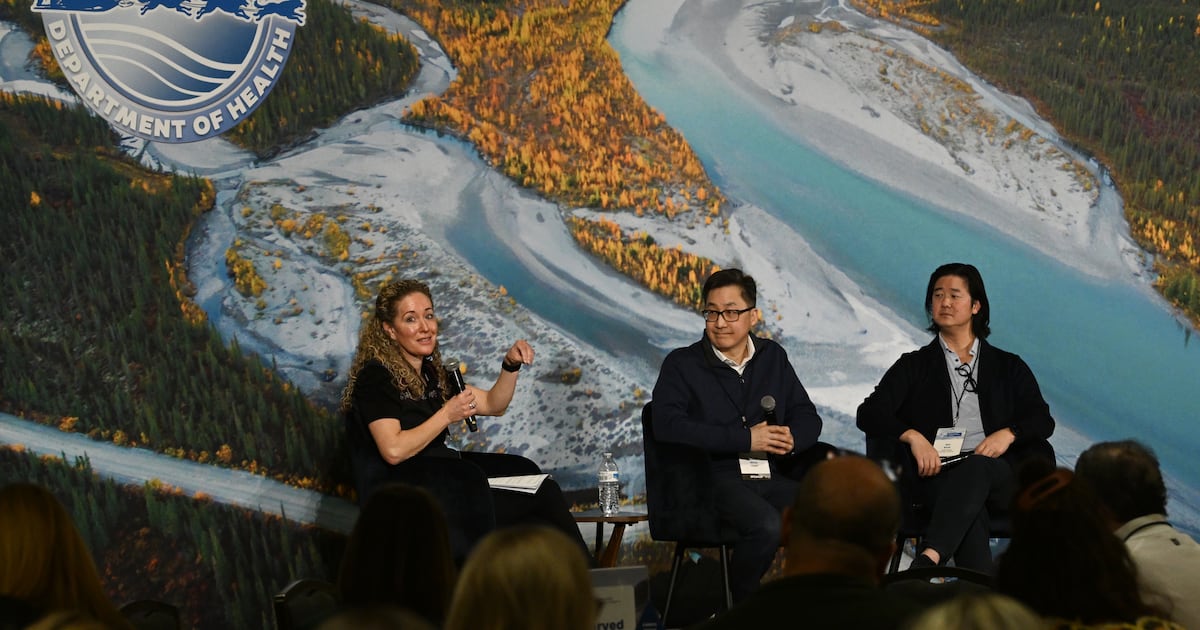
At an Anchorage convention on a new rural health program that will send Alaska hundreds of millions of federal dollars, a slate of Outside companies were keen to claim a slice of the state’s funding pie.
Alaska is a big winner in a newly formed Rural Health Transformation Program created by congressional Republicans last year amid massive cuts to Medicaid. The program is set to send $50 billion to states over a five-year period. Alaska’s award for the first year of the program is $272 million — second only to Texas and the largest of any state when considering the funding per capita.
If Alaska receives similar awards for the program’s five-year duration, the state will have more than $1.3 billion at its disposal for “rural health transformation” through 2030.
In a convention organized by the Alaska Department of Health this week, the resulting rush of Lower 48 technology companies was on full display.
Representatives from 20 health technology companies, including Microsoft’s Global Chief Medical Officer David Rhew, traveled to Alaska for the convening on Thursday. The companies’ products include online mental health services for teenagers, virtual maternity care through an app, school-based telehealth and an artificial intelligence platform for primary care, among others.
The term “snake oil salesmen” was mentioned more than once.
“We’ve had these snake oil salesmen come to our doors, come to our clinics, come to our facilities, and say, ‘Have I got a deal for you — this is going to work great in your community,’” said Monique Martin, vice president of the Alaska Native Tribal Health Consortium, in a presentation Thursday. “And it doesn’t work, and they sort of, tail between their legs, hop back on that plan and get back to their community in the Outside.”
With a dose of skepticism, Alaska health leaders said they were still eager to hear from technology companies — and each other — as they face down the prospect of spending hundreds of millions of potentially transformative dollars with tight deadlines and restrictions.
Ken Bahk, a health technology startup founder and investor based in Chicago, put it simply when presenting alongside Alaska’s Health Commissioner Heidi Hedberg: “You shouldn’t listen to people like us.”
“Trust but verify,” he clarified, as an audience of hundreds laughed.
Hedberg said Bahk was “nailing it” when describing the tension between the opportunities for Alaska’s health care providers to use this money to implement new technology, and the likelihood that technologies developed in Silicon Valley would prove ill-fitting in Alaska’s most rural communities, where internet access is unreliable and the ability to travel can change with the weather.
“For many of us, we look at this opportunity, and we know we need to lean into technology, right? How do you decide which one is right?” said Hedberg.
Discussions on artificial intelligence were front and center in a room that brought together Alaska clinicians, tribal health executives, lobbyists and politicians. Both Outside health executives and Alaska politicians spoke in grand terms about the prospective impact of the funding, touting wearable gadgets and AI-driven models that can better triage patients and streamline preventive care appointments.
“This could be the beginning,” Gov. Mike Dunleavy said in the convention’s opening remarks. “The moment that not only Alaska helped transform the United States, but we helped transform the world when it comes to rural health, and the advancement in AI and data is going to be phenomenal.”
Dr. Mehmet Oz, who leads the Centers for Medicare and Medicaid Services under President Donald Trump, said in a video recording aired at the convention that Alaska “is already way out in front” in putting the funding to use.
“The Last Frontier is truly the first in this program,” he said.
Bahk, the health equity executive, said that the perception of Alaska as “the most rural” state puts it as an advantage as it puts the new funding to use, but also means the state will likely be treated as a testing ground for new ideas — some of which will fail.
“All the stuff that you hear about people saying, oh, you’re in Alaska, you’re too — whatever it is? No. It’s flipped now,” said Bahk. “You’re going to end up developing the next generation of health care.”
Ultimately, the impact of the Rural Health Transformation Program could be curtailed by limits on the use of the money.
For example, the funding cannot be used to build new facilities, despite the fact that in some rural communities, new hospitals or clinics are among the most pressing needs. It also cannot be used to pay for the state’s Medicaid program, which serves one in three Alaskans, and an even higher share when counting the state’s most rural population. The funding cannot be used to pay for broadband internet access, even where its lack means many of the technologies discussed would be unusable. And the funding must be obligated by the end of each yearlong funding cycle or else the federal government could claw it back.
“I think we’re all a little disappointed to see that we can’t use this funding to build some of those hard infrastructure pieces that we do sorely need across the state,” Department of Health Associate Director Betsy Wood said.
The tight timeline has generated a crush of interest in Alaska’s pot of funding. The in-person gathering in Anchorage drew hundreds, a day after the Department of Health hosted an online presentation that drew more than 1,000 participants. Many of them were from the Lower 48.
The department has yet to begin awarding portions of the $272 million, but said Thursday that it would begin doing so in the coming months.
Though technology companies were the focus of this week’s convention, state Health Department leaders said they were seeking funding proposals not just from hospitals and clinics across the state, but also from school districts, local governments and community centers.
“We know that what contributes to a person’s health — all of us — much of that happens outside of clinic walls,” said Department of Health Deputy Commissioner Emily Ricci.
At rural health convention, Outside companies rush to claim a share of Alaska’s funding