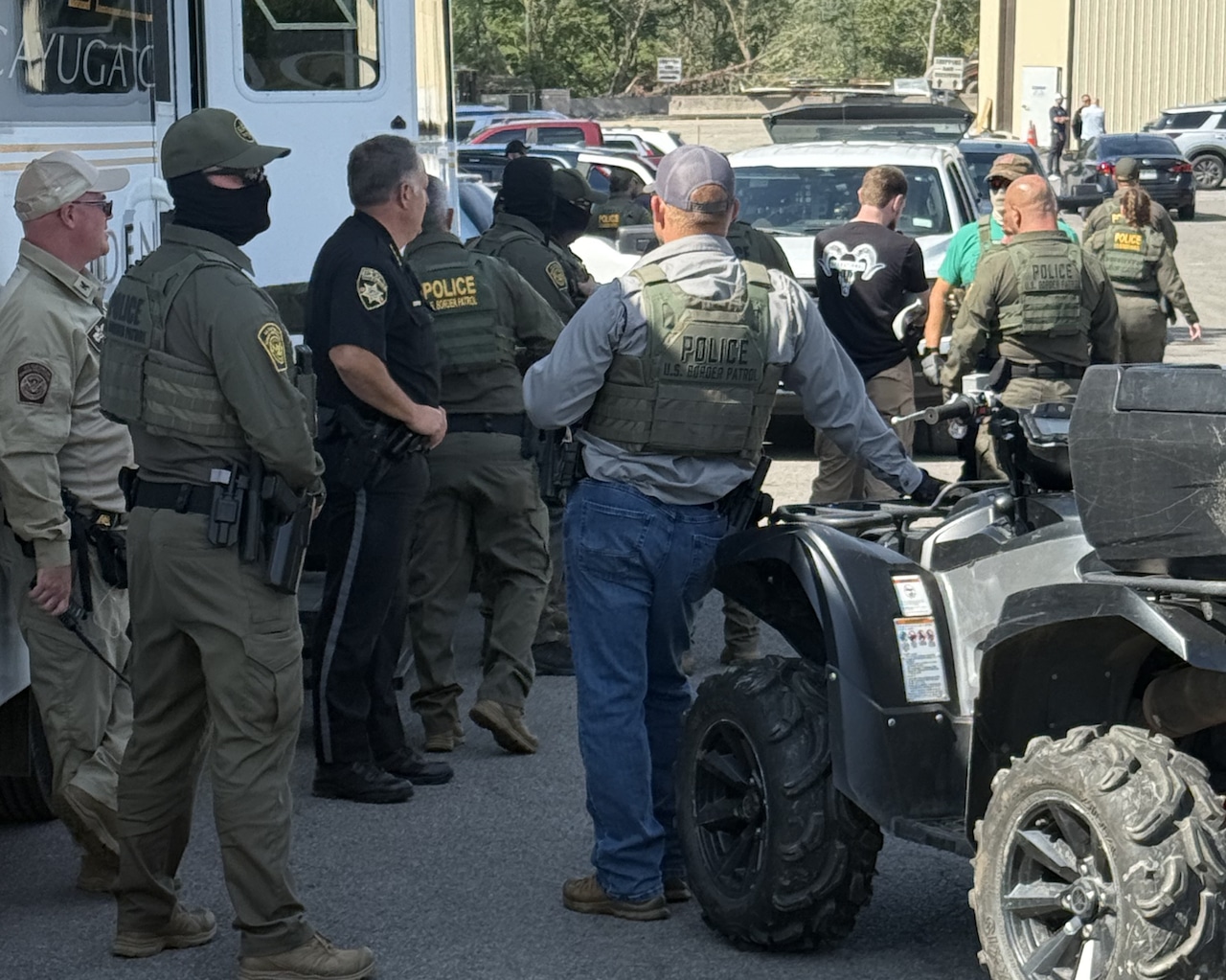
A woman arrested with 56 others at a Cato nutrition bar factory in September has filed a Constitutional challenge to the federal government’s immigration raid, saying the violations are “diverse, plentiful and compounding.”
In papers filed in federal court Monday, a lawyer for Argentina Juarez-Lopez asked Judge Brenda Sannes to exclude evidence federal agents collected after the biggest raid in Upstate New York since President Donald Trump took office.
Federal agents secured the wrong kind of warrant to enter the factory, the worker claimed. A so-called “Blackie’s warrant” is a warrant for administrative investigations that did not authorize a mass seizure of workers for questioning without attorneys, according to Paul Tuck, her lawyer and a former assistant U.S. attorney in Syracuse.
Federal agents did not have the required criminal warrant, he said.
Body camera footage described in new court papers shows the behavior of federal agents, who kicked in doors and ordered workers out of bathroom stalls, even as they sat on the toilet, Tuck alleged. Juarez-Lopez also said she was held with others in a small cell at the Oswego Border Patrol for four days before she had an initial court hearing in Syracuse.
On Sept. 4, dozens of state and federal law enforcement agents converged on the factory as part of a criminal investigation into the employment of unauthorized workers, Tuck said in court papers.
Agents detained 57 people. They were all Latino.
Many workers were sent to detention centers around the country and deported less than 72 hours later as part of a secretive administrative immigration court system.
The factory’s owners said federal agents told them they had a warrant for a violent felon.
The raid of Nutrition Bar Confectioners turned up five arrests of people who entered the U.S. illegally after previously being deported.
Two months later, no one has been charged with a violent crime or any other crime.
Juarez-Lopez was charged with illegal re-entry, a felony, in federal court because agents said she had been deported once before.
Unlike the administrative proceedings, federal court cases are open to the public, as are the related records. This case will shed light on the mass arrests in ways the other cases cannot.
In court papers, Tuck alleges, officers detained and arrested Juarez-Lopez without knowing her name or immigration status – a violation of the Fourth Amendment, which prevents unreasonable seizures. The U.S. Constitution applies to everyone in the country, regardless of citizenship.
Juarez-Lopez was working on a production line when a co-worker ran through the production area saying police had arrived.
Moments later, Juarez-Lopez said in documents, she saw an officer walking toward her. He wore a hat, a face mask and body armor. She turned and saw another officer dressed like the first officer, but wearing a handgun on his leg. They used hand gestures to move workers into the breakroom.
The room was crowded, chaotic and hot, she said. Officers yelled at employees to “sit down” or “stay here.” More armed officers pushed as many as 50 workers into a corner, she said in an interview filed in court.
Juarez-Lopez said she asked for a lawyer and did not make any statements about her immigration status.
Agents later said in their reports that she admitted at the factory to being in the country illegally and that she is a citizen of Guatemala, court documents said.
But the law enforcement body camera video supports her story, her lawyer said. Federal agents did not learn her name, country of origin or immigration status in the factory.
The video shows that agents questioned her for nine seconds, her lawyer said.
Even without that information, agents wrapped a chain around Juarez-Lopez’s waist and handcuffed her to the chain. They took her to the Oswego Border Patrol Station and did not tell her where she was, she said.
When they arrived, she asked to use the bathroom. They escorted her to a large cell with up to 30 of her female co-workers and told her to use a metal toilet with no door or privacy, she said.
“It was humiliating,” she said.
Federal agents held Juarez-Lopez in a small cell with one other woman for four days. Agents tossed out the makeup, toothbrush and medication in her bag. She was not allowed to make phone calls, not permitted any reading materials and slept on a foam mattress and blanket. The cell was so small, there was not enough room to fully lay out, she said.
They were served the same meal for breakfast, lunch and dinner each day, she said.
“During this time, I had no idea where I was, where I was going, and what was going to happen to me,” she said.
Tuck asked the court to suppress any evidence the federal government developed after her seizure, including statements, fingerprints, a photo or any investigative reports.
“Argentina was the victim of a dragnet seizure of all employees at the factory without any factual support,” Tuck wrote.
Until now, the search warrant had been sealed in court records. Syracuse.com obtained a copy and reported on it shortly after the raid in September.
The warrant is nicknamed a “Blackie’s warrant” because it is the name of a party in a 1979 case in federal court in Washington, D.C., in which it was used. This type of warrant has been rarely used in New York and has not been tested in the 2nd Circuit, which covers Connecticut, New York and Vermont.
Courts have allowed this type of warrant to be used for inspections of property, for example, a housing code violation, Tuck said.
Earlier this year, two federal judges in Texas turned down the government’s request for a Blackie’s warrant, saying it was meant for administrative searches to check records, not a fishing expedition for undocumented workers, court papers show.
“This warrant should never have been issued, and even if it was valid, the government utterly failed to execute it faithfully,” Tuck wrote.
Cato immigration raid violated U.S. Constitution, says lawyer for detained woman