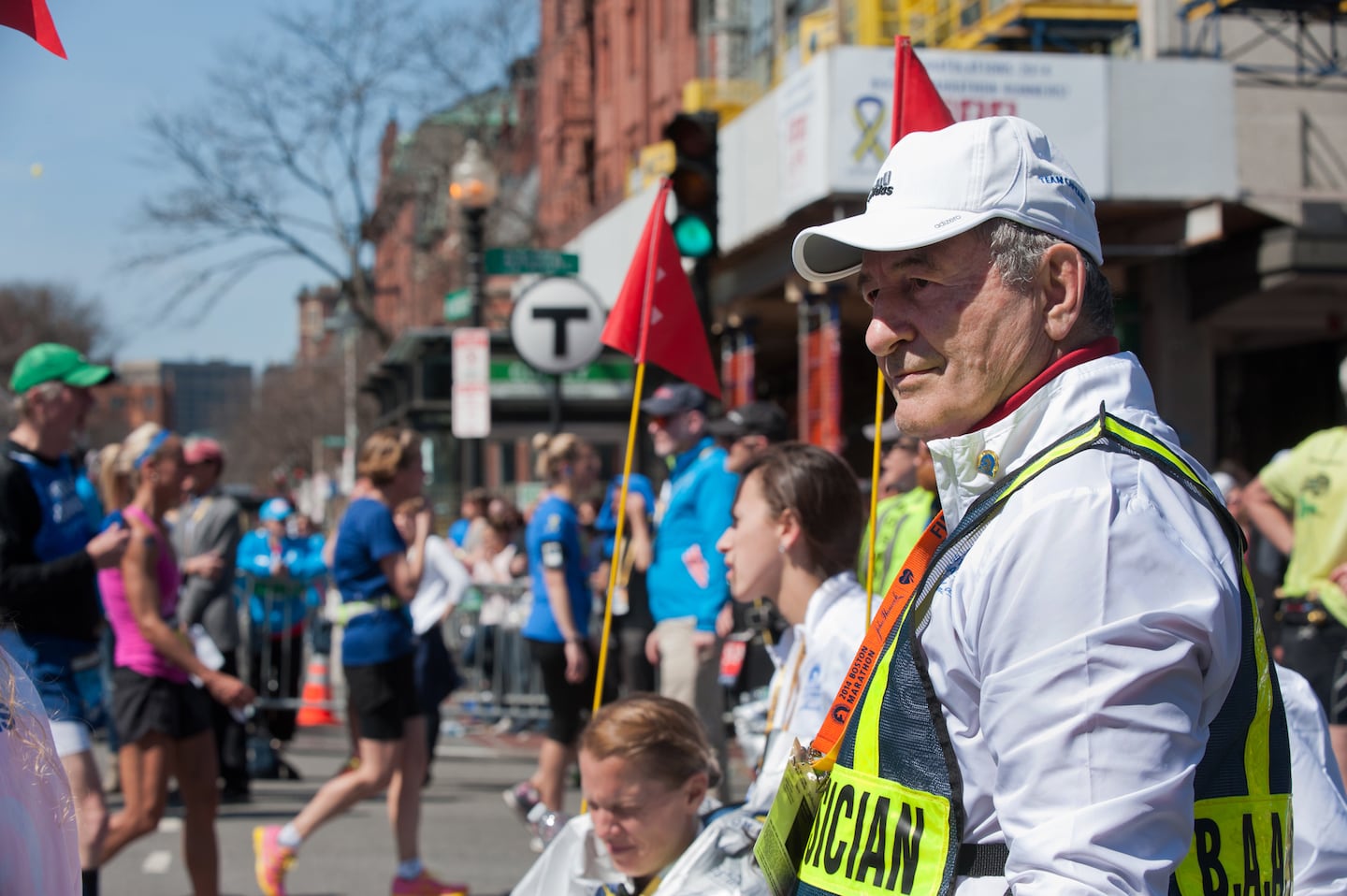
The proliferation of what he called “a new disease for children” led him to found the groundbreaking Micheli Center for Sports Injury Prevention in 2013.
Dr. Micheli, a surgeon who was also the Boston Ballet Company’s attending physician and a longtime director of finish line medical coverage at the Boston Marathon, died Dec. 14 in Massachusetts General Hospital of complications following a medical procedure. He was 85 and lived in Brookline, where for years he bicycled to work at the hospital.
Dr. Mininder Kocher, the current chief of the Division of Sports Medicine at Boston Children’s Hospital, said Dr. Micheli “actually created the field.”
Kocher trained under Dr. Micheli and called his mentor a pioneer and innovator of youth sports medicine and of youth sports injury prevention.
When Dr. Micheli founded the Micheli Center for Sports Injury Prevention, now located in Waltham and Norwood, he told the Globe that each week Boston Children’s Hospital physicians were seeing more than 450 young athletes with everything from sprains and broken bones to concussions and anterior cruciate ligament tears.
“Over the years, I’ve thought that we’ve got to be able to do something to intervene early and prevent these injuries,” he told the Globe just before opening the Waltham location in 2013.
Kocher, who also is an orthopedic surgery professor at Harvard Medical School, said that early on Dr. Micheli recognized and emphasized that when it comes sports, “youth athletes are not little adults” and needed specific approaches to injury treatment.
Dr. Micheli also treated adults in his roles as a Boston Ballet physician and at the Boston Marathon.
During the 2013 marathon bombings, he played an important role, less heralded in most media coverage, in leading his medical team to save the lives of many who were severely injured.
After the second blast, Dr. Micheli “just said, ‘Follow me,’” recalled Stephanie Burgess, the lead physician assistant in the sports medicine division at Children’s Hospital who worked with him for 13 years.
Dr. Micheli had a background treating severe injuries. He was an Air Force physician in Washington, D.C., during the Vietnam War, seeing military patients who had been flown back home.
While leading colleagues to the bombing victims, he noticed that the blasts had blown out the windows of a sporting goods store.
Stepping inside with his colleagues, he told them to “just grab as many articles of clothing, anything you can find, and bring them out to the street and start tying tourniquets on people,” Burgess recalled.
“I don’t know how many people we may have lost without his guidance,” she added.
In a 2014 oral history interview with the Center for the History of Medicine at Harvard’s Countway Library, Dr. Micheli described how he and a colleague fashioned a tourniquet from a clothes hanger and a running jacket to apply a tourniquet to a severe shrapnel wound.
“We had to improvise,” he said.
Lyle Joseph Micheli was born in LaSalle, Ill., on Aug. 19, 1940, and grew up in nearby Peru, Ill.
His father, Prodie Micheli, was a decorated World War II veteran who later worked in an auto parts business. He was from an Italian immigrant family of many relatives who had worked in coal mines in Italy and Illinois.
Dr. Micheli’s mother, Margaret Garcia Micheli, worked in defense plants during the war and died when he was a boy. She was from a Spanish immigrant family and had relatives who also had worked in mines.
Growing up, Dr. Micheli spent time with cousins among whom teasing and nicknames abounded. His mother summoned him to dinner by calling out “Butchie boy” from the family’s home.
After she died, “I learned that I could only depend on myself,” he said in a Story Corps interview with his younger daughter, Amanda Micheli, a filmmaker who lives in Alameda, Calif.
“I disappeared into the books,” Dr. Micheli said of his elementary school years. “I would read four books every week.”
Amanda said sports also became “a lifeline” for her father, and that sports and dogs became his lifelong loves.
A student athlete in high school and as a Harvard University undergraduate, Dr. Micheli became a devoted rugby player. He competed with Boston area clubs, participated in his last match at 60, and was inducted in 2017 into the US Rugby Hall of Fame.
Dr. Michael graduated from St. Bede Academy in Peru, from Harvard with a bachelor’s degree in chemistry, and from Harvard Medical School, where he later taught.
His first marriage, to Linda McJannet, an author and retired college professor, ended in divorce. The couple had two daughters, Amanda and Lisa Micheli, a climate scientist who lives in Sonoma, Calif.
Perhaps owing to Dr. Micheli’s childhood in a coterie of teasing cousins, “he had a great sense of humor – that ability to be so capable, but also to be able to laugh at yourself,” Lisa said.
In 1987, Dr. Micheli married Anne Jenks, who retired after serving as a nursing manager in various capacities at Children’s Hospital.
“I’m not saying this because he was my husband,” she said, “but he was an incredible surgeon, and he was so committed to his patients. Patients were first.”
Because of his longevity in the field, it became common for Dr. Micheli to treat three generations of many families at Children’s Hospital and his injury prevention centers.
“People would say, ‘He saved my knees. He saved my athletic career. He saved my whole family,’” Burgess said.
Anne recalled that some patients would say: “The knee he did was better than the one God gave me.”
Dr. Micheli never officially stopped working.
“Retirement wasn’t even in his vocabulary,” said Amanda, who recalled that her father “called it ‘the R-word’” and thought of vacation “as a four-letter word.”
Dr. Micheli’s younger brother, Thomas, died during the pandemic. In addition to his wife, two daughters, and former wife, Dr. Micheli leaves a grandson.
A memorial gathering will be announced in 2026.
Dr. Micheli formerly chaired the Massachusetts Governor’s Committee on Physical Fitness and Sports, and held leadership roles in many professional organizations, including as secretary general of the International Federation of Sports Medicine.
The author of numerous influential medical papers, he studied the movements of athletes and dancers to learn how to treat them and, ideally, to help ensure that they wouldn’t have to return to his office with other injuries.
“The more you know about a given sport or discipline like dance, the more useful the advice you can give,” Dr. Micheli told Boston Magazine in 2014.
In his holistic approach to treatment, he also sought to elevate the roles of trainers, physical therapists, and sports psychologists.
And in his recollections of the marathon bombings, he made sure to recognize unheralded student volunteers who arrived that day thinking they would help collapsed runners and instead wheeled severely injured victims to ambulances.
In the oral history, he noted that little mention is made of “the young athletic-training woman who’s pushing the wheelchair, who truly is the unsung hero.”
Dr. Lyle Micheli, youth sports medicine pioneer, dies at 85