Nearly 20 years ago, during a family dinner, Beth Damon, a medical professional, and her husband, a firefighter, heard their pagers buzz with a medical call. They paused, put down their forks and listened.
A neighbor was suffering a medical emergency.
They waited.
And waited.
Fifteen minutes later, an ambulance arrived.
“I thought, ‘I wish we could do something that would help our friends and neighbors quicker,’” Damon said.
An idea was hatched.
Damon spoke with local emergency medical services and learned how a first responder unit works.
Damon formed the Otisfield First Responders in 2009. The first roster included about five people, mostly emergency medical technicians, or EMTs, who worked for other emergency medical services and lived in town.
“We have these people in town. Why shouldn’t we go to help when we can? So that’s what we did,” Damon said. “The first responder service has been going since 2009, with ups and downs.”
It can take 20 minutes for an ambulance from MaineHealth Emergency Medical Services — known as PACE until 2024 — to reach parts of Otisfield from MaineHealth Stephens Hospital in Norway. The town’s first responders help bridge that gap, stabilizing patients until an ambulance arrives.
Licensed to the EMT basic level, responders can assess patients and provide aid, but they cannot transport them to the hospital.
Damon said the group’s basic mantra is to stabilize patients until help arrives. That can mean starting CPR, intubating, running IV lines, administering medications or handling heavy lifts.
When the situation is critical — such as when someone is coding, meaning the patient is in cardiac arrest — they provide extra support.
“Sometimes, the more people you have there, the better, when you’re working on a code,” Damon said.
Robert Hand, director of MaineHealth EMS in Norway, said his crews responded to 228 calls in Otisfield this year. When staffing allowed, the Otisfield First Responders were valued partners.
“They get toned out to the call along with us for every call we do out there – people who live in the town, helping each other out,” Hand said. “It’s a very nice thing to be able to do.”
It also helps address the very real resource limitations of providing coverage in rural Maine.
“We cover nine towns in total. It could take you an hour and 20 minutes to drive across our coverage area,” Hand said. “So our times to Otisfield, you’re looking at 15 minutes or so, depending on the weather. If you can get the responders there, at least they are starting care, making patient contact and delivering service while we’re on the way.”
The relationship between MaineHealth EMS — part of MaineHealth Stephens Hospital — and the Otisfield First Responders is a key component of the program’s success.
“We have a good working relationship with PACE,” Damon said. “We try to train together at least once a year, and we work well together.”
Not every call is an emergency, and the Otisfield First Responders have discretion over which ones they answer.
“We get paged for everything,” Damon said. “If I’m sitting here and available, and I hear the disposition of the call — basically the doctor wants the person to have a ride to the emergency room because they need to be checked out — I’m not going to go.”
Any first responder will say that calls are not always what they seem. As Damon noted, even seemingly routine calls can turn into serious medical emergencies.
“There are plenty that are general sickness calls that you’re thinking that this is just a nothing call, and it’s, you know, they don’t need us or whatever. They just need to get to the hospital,” Damon said. “And then you find out later that the person had a heart attack.”
Damon said members of the Otisfield First Responders answer the calls they can, when they can.
“Basically, if you’re in town and if you’re available, you have a pager, you hear a tone, and if you’re able to respond, you get care started and get an assessment done,” she said. “We do not transport, but we can get something done to help PACE. If we can do something to, you know, get help quickly before PACE gets there, we do.”
Damon said one of the hardest parts of the service circles back to why the Otisfield First Responders were formed: answering emergencies involving friends, colleagues and neighbors. With a population of fewer than 2,000, Otisfield is far from a metropolis, and Damon said she often provides care to people she knows or with whom she has worked during her hospital career.
“But unfortunately, I mean, I’ve done CPR on people that I sat in the meeting next to the day before,” Damon said. “It’s part of it. It’s part of the profession. You have people talk about PTSD (post-traumatic stress disorder) and things like that. I mean, everybody carries some level of that. I mean, you just do.”
The members of the Otisfield First Responders are also facing internal challenges, including recruitment. Damon said there are not enough people on the roster to cover incoming calls. Most of her staff members work out of town, and there are no scheduled shifts.
When the service began in 2009, Damon said, it responded to about 100 calls. Last year, it answered between 20 and 30.
“We don’t have a lot of people responding, and part of it is everybody works out of town and has full-time jobs, and it’s hard to get people sometimes to turn out in the middle of the night when they’ve got to go to work the next day,” Damon said.
Two members work full time at professional fire departments, putting in 80 to 100 hours a week and responding to only one or two calls a year because of their limited availability. The rest of those on the roster have day jobs: two are teachers, one is a consultant and Damon still works per diem as a physical therapist at MaineHealth Stephens Hospital.
Another issue that cuts to the heart of the recruitment problem is aging. Damon said it has been difficult to find younger people willing to take up the helm.
“Our whole Fire Department is aging, and we are working hard to try to get the younger people,” Damon said. “It takes a lot of time and commitment away from families, away from your job, to maintain the level of education that’s required.”
And Damon said the cost of obtaining basic EMT training has skyrocketed. When she took her class years ago, it was a 180‑hour time commitment and cost $350. Classes now cost more than $1,000, making it much harder for a young person to afford.
The sudden rise in the volume and intensity of mental health-related calls is another major challenge for the service. Damon said the increase has been drastic, and the responders are underequipped to handle it.
Damon said the safety of her crew is her most serious concern as EMS chief. Otisfield does not have a police department, and the town relies on the Oxford County Sheriff’s Office for coverage.
She said deputies often respond to calls on their own and are alone at the scene until an ambulance arrives.
“We don’t have the resources and, in my opinion, the training for a lot of it,” Damon said. “As an EMS chief, I basically tell my people, my crew, that your safety is more important than anything. If you are not comfortable, then don’t feel guilty about not responding.”
Despite the challenges, the service remains valued in Otisfield, especially in the summer. Damon said the town has a relatively small year-round population, but it swells during the warmer months. Many summer visitors stay in camps along twisting, treacherous and aging camp roads. During the dog days of summer, when ambulance drivers may rely on fallible GPS, members of the Otisfield First Responders can draw on their local knowledge to find properties.
“So, yeah, I mean, and yeah, we can get to them a lot quicker,” Damon said. “We can find them sometimes a lot quicker on those camp roads and stuff like that.”
Damon said the service does not bill patients, and the town covers its operating costs. It relies on tax dollars and the Fire Department’s budget to stay afloat.
“We don’t have a huge budget,” Damon said. “We don’t pay payroll for anyone sitting around waiting for a call. We only get paid while we’re on the call. It’s not a lot. First responders don’t make a lot.”
But they still show up.
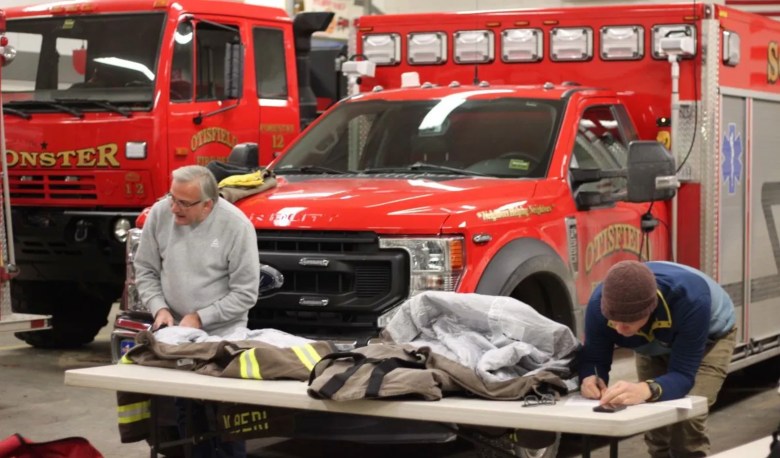
On a frigid December night, members of the Otisfield Volunteer Fire Department and Otisfield First Responders gathered for training at the Spurr’s Corner Fire Station. In the shadow of the department’s massive trucks, the crew members inventoried their gear and checked items off a list.
They swapped stories about the day’s calls — including a major one at 5 a.m. — as Damon oversaw the gathering, pausing when radio traffic cut through the din.
Scott Berk, owner of Café Nomad in Norway, was among the firefighters in attendance. He serves in both Norway and Otisfield and is part of the Otisfield First Responders team. Berk joined the department about 10 years ago and earned his EMT certification in 2021, during the COVID-19 pandemic.
“As a kid, I wanted to fight fires, and I got to a place in my life where I felt like I could join, so I did,” Berk said.
Berk primarily responds to fire calls, but lends his skills to the Otisfield First Responders when he can.
An outdoorsman, he has participated in a few outdoor rescues and holds a Wilderness Rescue certification.
“I can help people on the worst day of their life, potentially, and make a difference,” Berk said. “If we show up, someone is having a bad day. But there is someone to show up and help them. It’s a really important part of these rural communities.”
According to a 2024 study indexed in the National Library of Medicine’s PubMed database, 57% of EMS workers are likely to suffer burnout, a state of chronic exhaustion from prolonged exposure to high stress. Heavy call volume and limited staffing can leave a single responder handling many calls, sometimes traumatizing, without a real break. The mix of overwork and trauma can lead to emotional strain, especially after difficult calls.
For Damon, 67, who still responds to calls and leads the crew, the sheer physical demands of the job have grown daunting.
“For me now, the physicality of it is harder to do than it used to be,” she said.
And so is the lack of sleep. These days, getting up at 2 a.m. for a tone is not as easy as it once was. What keeps Damon going is knowing her community needs her.
“It takes a special type of person to commit to this kind of thing,” she said. “I mean, you’ve got to really have a caring for your community, wanting to make a difference. You can’t do it for the money. You can’t even make a living wage doing EMS without having to work two or three different services.”
So why do it?
It circles back to that dinner in 2009, when Damon’s neighbor had to wait during a medical emergency.
“I mean, you’ve just got to be really committed to the health and welfare of your community and helping people in the way you know how,” Damon said.
This is the way Damon knows how to help. Sometimes she runs into people she has served. She might not always remember the calls or the faces, but she is approached and thanked all the same. And the gratitude helps propel her forward.
“You can have some bad experiences and feel underappreciated,” Damon said. “And then it just takes one call where you feel like you really made a difference. And then it sparks you all over again.”
For information on how to volunteer, send an email to vog.emdleifsito@feihcerif.
Members of Otisfield First Responders are neighbors helping neighbors