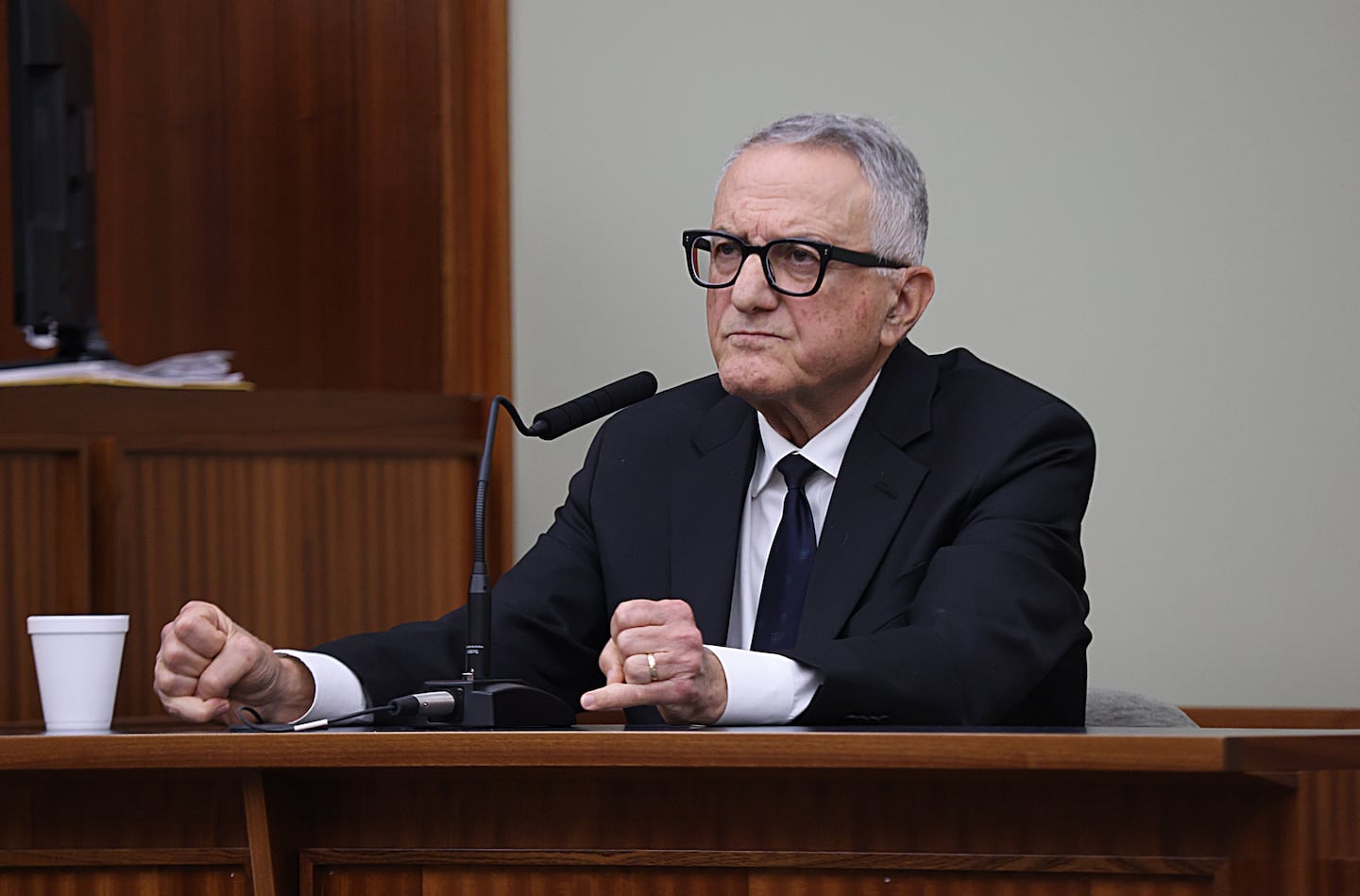
Sherry Naso wasn’t his “regular patient,” Ghoreishi testified — she had a team of oncologists for her breast cancer, a primary care physician, a psychiatric nurse practitioner, and other doctors — but his daughter came to him when she had complaints. And, except for prescription refills, he testified, Ghoreishi mostly wrote down his treatment in her patient chart. He didn’t tell her doctors about his care.
On Wednesday, the eighth day of a Family Court hearing where Ghoreishi and his wife, retired pathologist Dr. Jila Khorsand, are seeking visitation with their granddaughter, Ghoreishi was asked to review the records of the 124 prescriptions he wrote for his daughter and his handwritten patient chart covering the last four years of her life.
He read aloud from March 30, 2024. His notes said that Sherry had a cough and nasal discharge, but no temperature, and she tested negative for COVID-19. Ghoreishi thought her lungs sounded clear. His impression was she had a viral infection and allergic rhinitis, so he prescribed allergy medication. He saw no need to order imaging.
Two weeks later, a neurologist who is a family friend took one look at Sherry’s drooping frame and ordered an MRI, which found a 4.2-centimeter brain tumor and lesions in her skull. The breast cancer she’d been fighting since June 2017 had spread throughout her body, including her lungs and liver.
She died on April 24, 2024.
Ghoreishi and Khorsand have taken their son-in-law to Family Court for refusing to let them visit with their only grandchild, 4-year-old Laila.
State law allows grandparents whose children have died or divorced to petition the Family Court to order visits with their grandchildren.
Scott Naso, a Middletown police detective, stopped allowing his in-laws to visit with his daughter in the summer of 2024, because he believed their medical care contributed to Sherry’s death.
After his wife died, Naso discovered that Ghoreishi, who was also Laila’s pediatrician, had written dozens of prescriptions for Sherry and Laila. Naso also found text messages that Khorsand had written to Sherry that misdiagnosed her symptoms of weakness, numbness, and bowel trouble as caused by lymphedema and weaning off Prozac.
Judge Felix E. Gill will determine whether Naso’s decision to end visits is reasonable. If not, the judge may allow visitation if he finds it’s in Laila’s best interests.
The hearing started with a week in October and continued for three days this week. Gill will resume hearing the case on Feb. 23. At least a dozen witnesses may be called to testify, including Naso.
Khorsand and Ghoreishi are the only witnesses who have taken the stand so far. Both have maintained they have done nothing wrong and that they had a close relationship with Laila and Sherry.
In his testimony on Oct. 24 and since Monday this week, Ghoreishi has been questioned by Naso’s lawyer, Veronica Assalone, about his medical care of Sherry.
On Monday, Ghoreishi testified that he was “unaware” until the Family Court hearing that the American Medical Association Code of Ethics and the state Health regulations warn physicians against treating close family members. On Tuesday, he clarified that he hadn’t known the code of ethics “line by line.”
On Wednesday, he defended his medical care of Sherry, as Assalone led him through the batch of CVS records of Sherry’s prescriptions and her patient chart.
Ghoreishi was questioned about diagnosing his daughter with gastroparesis caused by Ozempic in the summer of 2023. He acknowledged that wasn’t in his scope of practice as a pediatrician, but testified that he felt confident in his diagnosis because he’d been reading about it and he had similar issues while taking Ozempic himself.
Ghoreishi said he looked up treatment through the Mayo Clinic online, and prescribed his daughter reglan, or metoclopramide, and chlorpromazine, a drug that is prescribed for schizophrenia, but can also be used for nausea.
Assalone asked Ghoreishi if he was aware that treatment protocol also requires imaging to check for possible blockages. He said he wasn’t aware.
“I knew they were recommending a lot of things, but when I started my treatment and she improved, I didn’t think she was going to need imaging, endoscopy, and sophisticated tests,” Ghoreishi testified.
Under questioning, Ghoreishi said he wasn’t aware if the drugs posed a risk for cancer survivors.
“And yet you prescribed them,” Assalone said.
“Yes,” Ghoreishi said.
Assalone showed Ghoreishi photos of Sherry’s phone, of text messages between Sherry and “Dad,” discussing her getting Ozempic.
“Do you recognize that to be a text string between you and Sherry?” Gill asked Ghoreishi.
“Could be. I don’t recall,” Ghoreishi told the judge.
Gill admitted the string of texts as a full exhibit. However, he cautioned, there is a difference between admissibility of the texts and the weight he will give them when he makes his decision on visitation.
As Assalone began questioning Ghoreishi about what the messages said, the retired physician frequently said he didn’t recall.
Sherry texted about numbness in her extremities, “my back hurts, my numbness, and my leg is worse,” Assalone said.
“Do you recall that, sir?” Gill asked.
“No,” Ghoreishi said.
“Did you ever ask Sherry in the months leading to her death what her pain scale was?” Assalone asked.
“I don’t recall,” he said.
The judge asked if he used the term “pain scale” to assess pain.
“I don’t remember if I have used it,” Ghoreishi responded. “I don’t use pain scales the way adult doctors do.”
“So, you don’t recall her telling you that her pain was 9.5?” Assalone asked.
“No,” Ghoreishi answered.
He will retake the stand when the hearing resumes in February.
Questions about doctor’s medical care continue in R.I. grandparents’ visitation case