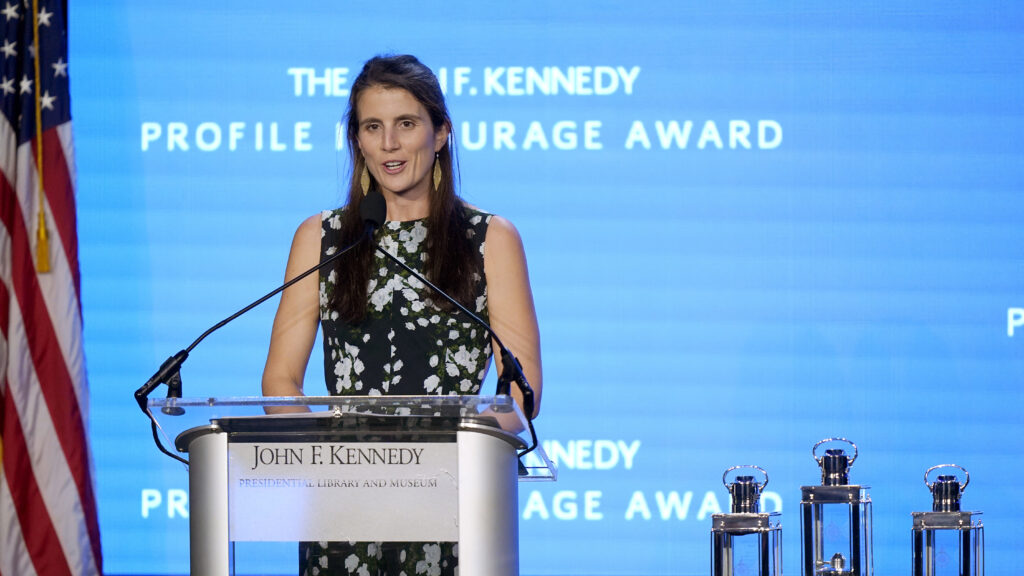
Tatiana Schlossberg, granddaughter of President John F. Kennedy, revealed a terminal cancer diagnosis in a New Yorker essay published Sunday, on the anniversary of her grandfather’s 1965 assassination. She used the moment to call out her cousin, Secretary of Health and Human Services Robert F. Kennedy Jr., for policy decisions and budget cuts that threaten the health of those in the United States and beyond.
The Kennedy family has long understood what it means when medicine fails. In August 1963, Jacqueline Kennedy gave birth to a son nearly six weeks early. Patrick Bouvier Kennedy weighed just over four pounds, and his first breaths made clear something was wrong. His tiny chest fluttered and retracted — the effort of a body laboring to breathe. He was rushed to Boston Children’s Hospital, where doctors placed him in a hyperbaric chamber to flood his bloodstream with oxygen. But less than two days after he was born, Patrick died. The diagnosis was hyaline membrane disease — what we now call neonatal respiratory distress syndrome — the leading cause of infant death in the United States at the time.
Advertisement
The nation mourned. Researchers, already deep into the science of newborn lungs, began asking harder questions about a disease that killed approximately 25,000 babies each year. The illness was a mystery — respiratory failure that oxygen wouldn’t treat.
But researchers had been assembling pieces of the puzzle. In the mid-1950s, physiologist John Clements discovered that lung tissue contained a substance that reduced surface tension in the tiny air sacs of the lungs — bubble-like structures called alveoli. In 1959, Mary Ellen Avery, a pediatrician at Harvard researching lung mechanics, examined the lungs of infants who had died of hyaline membrane disease. She found that they all lacked surfactant.
Their alveoli did not fail mysteriously; they obeyed the laws of physics. Equations developed earlier to describe soap films and spheres predicted what Avery observed: without surfactant to reduce surface tension, the microscopic sacs collapsed like punctured soap bubbles. No amount of supplemental oxygen could pry them open. Life or death came down to bubble geometry.
Advertisement
Yet in 1963, when Patrick Kennedy was born, this knowledge had not yet become treatment. The pieces existed, but no one had put them together in time to save his life.
Moved by his son’s death, President Kennedy signed legislation authorizing $265 million — more than $2 billion today — for research into newborn health. Federal funding began flowing to scientists studying the chemistry of lung development, the molecular structure of surfactant, and the physics of breathing.
The work was slow. Researchers had to determine whether surfactant could be synthesized or extracted safely, and how to deliver it into the airways of fragile infants. Each question demanded years of patient investigation, supported by grants unlikely to yield results for a decade or more.
Nearly two decades after Patrick’s death, pediatrician Tetsuro Fujiwara led a team in Japan that tested surfactant replacement therapy on ten premature infants, using surfactant extracted from bovine lungs and delivered directly into their airways. Within hours, babies whose lungs had refused to inflate began breathing on their own. Eight of the 10 survived; the remaining two died of unrelated causes. Clinical trials followed worldwide. By the 1990s, surfactant replacement therapy had become standard care.
“We hardly worry anymore about a baby like the Kennedy infant,” Camilia Martin, a neonatologist at Beth Israel Deaconess Medical Center in Boston, later said in the New Yorker. “Survival at thirty-two weeks’ gestational age is nearly a hundred percent.”
This is what sustained investment in research accomplishes. It transforms tragedies into breakthroughs. It turns impossible questions into routine treatments. But it requires patience, funding, and trust that scientists pursuing abstract questions in math, physics, chemistry, and biology will eventually save lives.
If Robert F. Kennedy Jr. responded to Tatiana Schlossberg’s terminal cancer diagnosis the way his uncle responded to his infant son’s death, he would expand research funding, not cut it. He would champion the scientists working on oncology breakthroughs, not dismiss medical expertise. He would trust that today’s abstract research questions might become tomorrow’s lifesaving treatments.
Advertisement
Instead, Kennedy has proposed deep cuts to the National Institutes of Health. He has amplified skepticism of vaccines despite strong evidence of their safety and efficacy. He has elevated personal intuition over the accumulated knowledge of doctors, medical researchers, and public health experts.
The consequences are concrete. Federal funding supports the researchers who may one day treat Tatiana Schlossberg’s cancer — or prevent cancers in others. It supports the virologists developing vaccines, epidemiologists tracking emerging diseases, and oncologists designing targeted therapies.
Cut that funding, and you do not eliminate waste. You eliminate possibility. You ensure that when the next family faces a medical crisis, the knowledge that might have saved them will simply not exist.
Tatiana Schlossberg carries both her grandfather’s legacy and her own diagnosis. Her grandfather built institutions that turned grief into knowledge. Her cousin is dismantling them. One generation of Kennedys understood that progress requires sustained investment in research. Another is ensuring that future patients will face illnesses we might have learned to cure.
Tatiana Schlossberg’s diagnosis shows two Kennedys, two paths