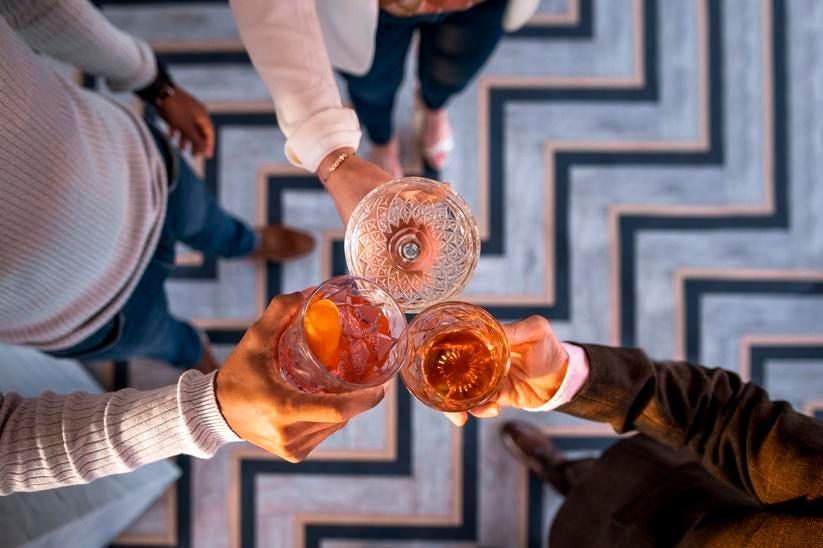
As more people have begun making the decision to drink less alcohol, non-alcoholic beverages are proving to be more than just a trend.
The benefits of drinking less
Joy Bauer, MS, RDN, CDN, nutrition and healthy lifestyle expert on NBC’s TODAY show, #1 New York Times bestselling author of 14 books, and founder of beJOYLY, a science-backed supplement company for adults over 50, points out that there are many health related reasons people of all ages are choosing to drink less alcohol. “Recent research has shown that easing up (or skipping it altogether) can lead to better sleep, a clearer mind, improved mood, more energy, stronger immunity, and even a bit of weight loss. Plus, there are hidden benefits you can’t see or feel, like lower blood pressure and a reduced risk for certain cancers and chronic diseases.”
For example, she shares, “In one study, women ages 40–60 who participated in Dry January reported better sleep, reduced fatigue, and sharper thinking after just one month of abstaining. Another study of more than 21,000 heavy drinkers found that those who reduced their intake lowered their risk of cardiovascular events—like stroke—by 23%.”
Self-care is also an important factor for many. Cygne Cooper, Co-Founder and Chief Creative Officer of non-alcoholic functional seltzer hiyo (which stands for happy in your own), shares, “Over the past few years, we’ve seen a major shift in how people approach both socializing and self-care. Nearly 49% of Americans say they’re actively trying to drink less — and in just two years, from 2022 to 2024, the U.S. has added 37 million new no-alcohol and 36 million low-alcohol consumers. But it’s not necessarily about drinking less, it’s about living more fully and making choices that reflect how they want to feel.”
How NA beverages have evolved: from replacement to enhancement
As the category matures, Cooper says, there seems to be less of an emphasis on replacement and more on enhancement. “Consumers are seeking beverages that fit seamlessly into a more balanced lifestyle, supporting both body and mind, while looking just as great as they taste. The focus has shifted from restriction to elevation: people want to enjoy the ritual of a drink while still feeling their best the next day.” They’re also paying more attention to ingredients that support mood, focus, and stress levels while looking for products without excess amounts of sugar, a common issue in the space.
Holly Berrigan, Chief Executive Officer of Boisson, an online marketplace for non-alcoholic options that recently launched a wine club subscription in partnership with award-winning sommelier André Hueston Mack, says, “Over the past few years, we’ve seen a meaningful shift from ‘abstaining’ to ‘intentionally choosing.’ Consumers today aren’t just looking for what’s missing in a non-alcoholic beverage, they want what’s added. They’re prioritizing flavor complexity, craftsmanship, and a sense of occasion. People want options that allow them to socialize more mindfully without compromising on taste, quality, or the ritual of a great drink. Ultimately, consumers are embracing non-alc as a way to support wellness, balance, and flexibility rather than restriction.”
MORE FOR YOU
The push for better quality and a more inclusive drinking culture
Though the category has been evolving in recent years, it’s still fairly new, and as new brands rush products to market, that doesn’t always bode well for quality.
Paul Beavis, CEO of Wild Idol, a premium sparkling alcohol-free sparkling beverage. “The category is still so young—it’s really only four years old—and it’s exploding in terms of people coming into the space.”
Consumer standards are also evolving, he adds. “When there is a new, evolving category, people come in at an entry level. They want to produce something that checks the boxes, but like with most things, consumers will continue to look for better and better quality products with the best ingredients. It’s not about volume at any price—it’s about using the best quality ingredients.A few years ago, people thought it would be just the younger generation that wasn’t drinking (or drinking less), but we’ve found it’s much more broad than that. Even for people who do drink, they’re drinking less and they’re choosing higher quality products when they do drink. “
Beavis, whose background is in champagne, shares that when Wild Idol jumped into the space, “the vision was to have something natural, to have the product straight from the vineyard but without the fermentation of alcohol. My background is in champagne and I knew that it needed to include the terroir from the soil.and to not go through the dealcoholization process and have to include other flavoring agents to make it taste like wine.” While the company’s primary consumers are very health-conscious, he adds, “they don’t apologize for not drinking. And they don’t want to miss out. They want to celebrate.”
Cooper shares that the team at Hiyo also had gatherings and celebrations in mind. “At Hiyo, our vision is to lead this charge, making ‘social tonics’ a household term and Hiyo a household brand. We’re bringing that mission to life through partnerships like our new collaboration with Live Nation, which introduces Hiyo to 40 major music venues across the country, as well as retail expansion in Target, Whole Foods, and Sprouts nationwide. It’s all about meeting people where they are and making mindful drinking feel inclusive, exciting, and completely natural.”
Berrigan says that a major inspiration for the non-alcoholic wine club with Mack was wanting to help demystify non-alcoholic wine and introduce consumers to curated selections to help them explore with confidence. The partnership is especially meaningful, she says, because “doing it with someone so well known in the traditional wine space gives that education and clarity to our customers.”
More established brands in the space have certainly noticed shifts in who’s purchasing their products and what’s most in demand. Ashley Jappe, Senior Director of Marketing, Trinchero Family Estates, a family-owned global wine and spirits company known for producing a wide portfolio of award-winning brands, including Sutter Home and FRE.
“When FRE launched in the late 1980s,” she says, “the consumer had a specific functional need: pregnancy, health, medication, or a religious reason. Non-alcoholic wine solved a constraint and allowed people to stay in the ritual of wine without the alcohol. For many of those early adopters, especially older consumers, loyalty ran deep. Once they found a non-alc option they trusted, they stayed with it and wove it into their routines. Over the last decade, that motivation has expanded into something more lifestyle driven. Health is still central, but it shows up as a desire for clarity, better sleep, stable energy, and the ability to move through a week with more focus on how they want to feel. People are weighing not just whether they can drink, but what role alcohol plays in their physical, emotional, and social lives over time.”
She adds that there is also far less stigma around the choice to drink or not drink. She also points out that for many consumers, “it is common to zebra stripe across the spectrum: full ABV wine, non-alc, functional beverages, THC, CBD, sometimes all in one night. There are more options than ever before, and consumers are more open to trying products that fit different moments and needs. Alcohol now sits inside a broader personal wellness and lifestyle portfolio, not outside it.”
For FRE, she says, the company’s consumer base has widened. “We still serve people with a specific functional need, and at the same time, we are increasingly serving consumers who are moderating, training for something, supporting a partner, or simply holding higher standards for how they feel and connect in their daily lives. Non-alc wine has shifted from a workaround to a deliberate choice.”
Functional NA beverages: the demand for mood, focus, and stress support
Functional beverages have become increasingly popular as well, with customers looking to support their wellbeing through their food and drink choices.
Juni is a functional beverage made with natural botanicals, adaptogens, and superfoods designed to support mood, focus, and overall well-being without added sugars or artificial ingredients.
Radhi Devlukia-Shetty, who created Juni in partnership with her husband Jay Shetty, says, “Research shows we’re the mosy stressed we have been and are struggling with mood disorders, depression, and ADHD. Every person wants to feel happier and uplifted. Our packaging is bright because we want even looking at the product to be uplifting. We are thinking about each detail. If one of our products tastes amazing but smells off, we send it back and keep working. We want to engage all the senses. We’re thinking, how can we create a moment for them to feel present in time. What can we do to help you with that? Lack of presence, stress, feeling low mood and low energy are the things research and our communities show we are struggling with the most. We want to use the adaptogens in our products to help.”
Kim Perell, Juni CEO and additional co-founder, adds that with the rise of functional beverages. “people are looking for specific benefits. They’re not looking for just hydration anymore. They’re looking for stress relief, focus.People want something they can choose that is good for you that doesn’t sacrifice taste.”
Devlukia-Shetty says, “I think people are really interested now in the quality of ingredients they’re getting. We’re using all organic. We’ve really tried to have the best ingredients. I’ve noticed that with the health conscious community, this matters to them. They want to know where natural flavors are derived from, which is why we have information on that in the FAQ section.”
The way they approach product development and marketing, explains Perell, is that “Juni is more than just a beverage. It’s a moment to change people’s health habits and replace something [less healthy] they drink with something better.”
How to elevate your mocktails at home
Whether you’re choosing a ready to drink NA beverage or crafting your own using non-alcoholic ingredients, flavor and presentation matter.
Bauer shares, “I love mixing and matching ingredients! Some of my favorites: fresh lime and lemon juice for a citrus boost; muddled berries for natural sweetness and color; cucumber slices and herbs like mint or rosemary for spa-day vibes; and sparkling water for that refreshing fizz. For garnishes, I go all out…citrus wheels, edible flowers, a rim of crushed freeze-dried fruit (sometimes mixed with a dash of salt or sugar), or even a sprig of rosemary or thyme. It’s those little details that make a mocktail feel like a true celebration in a glass!” Some of her personal go-to drinks are her Blackberry Margarita Mocktail, Strawberry Peach Mimosa Mocktail, and Pineapple Moscow Mule Mocktail.
Choosing enticing glassware can also make a big difference when it comes to making your beverage a satisfying experience.
Embracing the non-alcoholic movement: what this cultural shift means
Berrigan says it’s important to embrace the movement. “The non-alcoholic category isn’t a trend, it’s a reflection of a cultural shift. People are redefining what celebration, connection, and enjoyment look like, and we’re proud to play a role in shaping that future. Our partnership with André represents the next evolution of non-alcoholic wine, and we’re excited to continue expanding access to exceptional, alcohol-free experiences for every kind of drinker.”
As non-alcoholic beverages become a staple, consumers are no longer simply avoiding alcohol—they’re actively seeking elevated NA beverages, crafted mocktails, and functional drinks that support well-being, inclusion and intentional living. With more options than ever before, the category continues to expand in quality, creativity and cultural relevance. Whether someone is moderating, training, exploring sobriety or simply choosing how they want to feel, non-alcoholic beverages offer a meaningful way to enjoy connection and celebration on their own terms.
The New Era Of Non-Alcoholic Beverages: Redefining Social Wellness