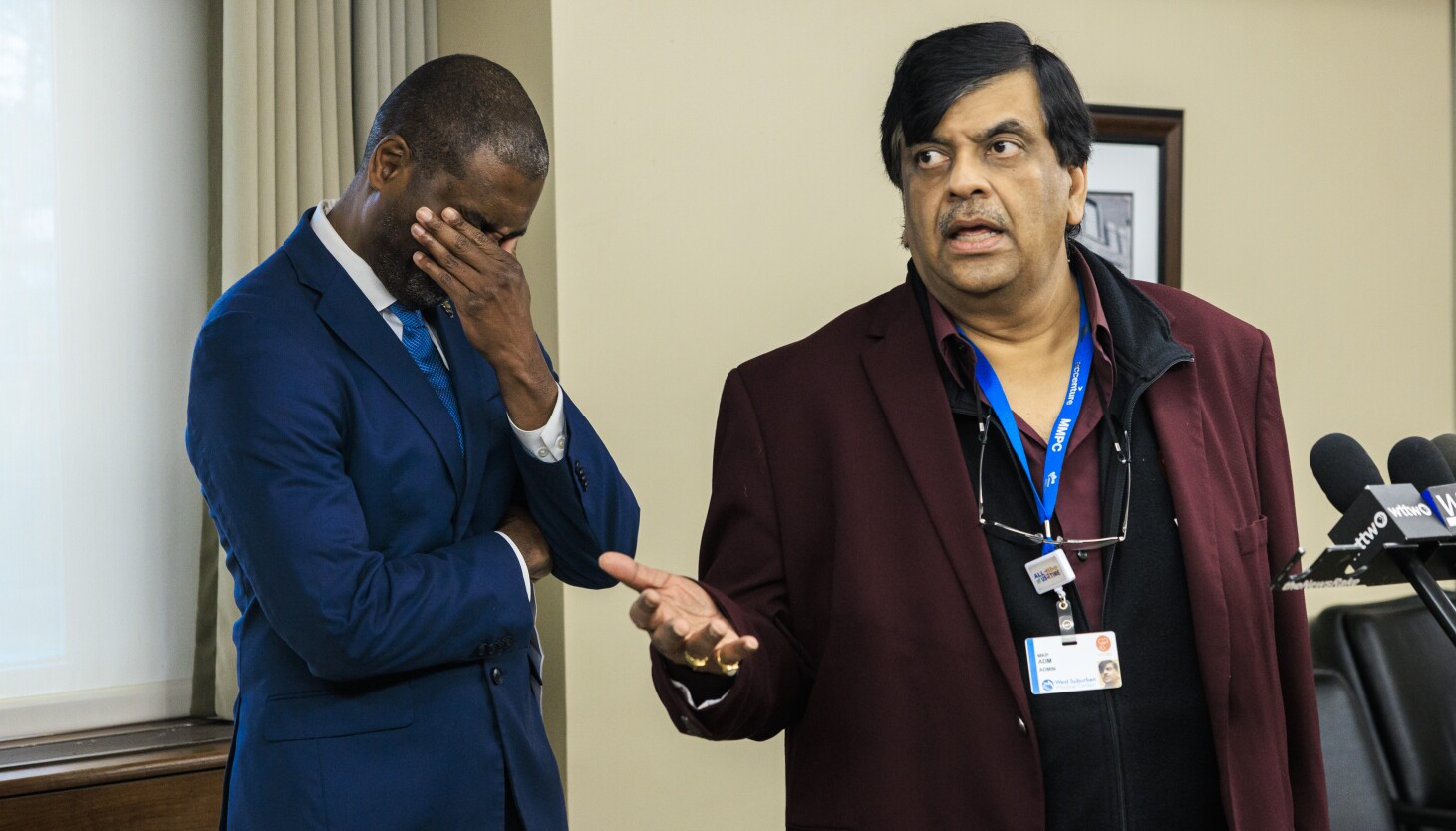
The owner of West Suburban Medical Center pledged to do everything he could to reopen the safety net hospital by this summer as he defended his leadership in a combative news conference on Wednesday.
But that comes as hospital inspection reports obtained by WBEZ and the Chicago Sun-Times paint a picture of broader problems at the Oak Park facility, of a hospital struggling to take care of its most critically ill patients — and even keep the heat on — in the months before West Suburban closed.
During a wide-ranging and chaotic press conference Wednesday, Dr. Manoj Prasad, the hospital’s owner and CEO of Resilience Healthcare, said West Suburban was troubled long before he bought it in 2022.
“We have already proven ourselves,” Prasad said in a board room packed with reporters at an otherwise empty hospital. “We have come in when nobody would even touch this place. We have kept it up and running for three and a half years.”
Prasad temporarily suspended services at West Suburban last week, saying he had no choice because the hospital’s electronic medical record system was not properly billing for services. The hospital took in 10 to 15% of its usual income for the last year, he said.
But in February and March, the hospital was investigated by the federal government twice for what’s known as “immediate jeopardy,” a serious allegation where inspectors believe patients could be at risk of serious harm or death.
West Suburban couldn’t x-ray three “unstable” patients — the four portable x-ray machines hadn’t worked for days — and didn’t have a doctor on call for several days to treat critically ill patients in the 16-bed intensive care unit, according to an inspection report from the U.S. Department of Health and Human Services.
A doctor told inspectors it’s difficult to diagnose patients with no portable chest x-ray. “I am guessing,” especially for unstable patients, the doctor said.
In one case, a patient who had trouble breathing and eventually went into cardiac arrest was resuscitated and brought to the ICU on a ventilator to help them breathe, the inspection report said. Doctors couldn’t get a portable x-ray for the patient’s chest to see if their condition was improving.
There was only one stationary x-ray machine that worked, but there was no back-up plan if it broke, the inspection report said.
In another case, a patient in the ICU was in septic shock and had coded. The only physician in the emergency department had to come to the ICU to try to revive the patient, who died.
An ICU physician who was on vacation during that time said doctors in the emergency department and nurses in the ICU “had no idea who to call if patients needed physician intervention in the ICU,” according to the inspection report.
Basic services at the hospital were gradually deteriorating, the doctor told inspectors.
Inspectors also found that the heat was out throughout the hospital in late October as replacement parts for the HVAC system were ordered. In some areas it was just 37 degrees. Some patients said they were comfortable in their rooms, while others were moved to other parts of the hospital, the inspection report said.
Several of these issues have been addressed, the reports say.
Patients, lawmakers and community leaders have criticized how abruptly West Suburban closed on March 25. The for-profit hospital mostly treats low-income and elderly patients. The majority are Black or Hispanic, public health data shows.
Patients were transferred to other hospitals, and employees furloughed. Prasad told the state nearly 750 people worked there.
The Illinois Department of Public Health has criticized the move, too. A spokesman said it was “a highly unusual and irresponsible situation” for Prasad to notify state regulators the same day he suspended services.
“The scale and the timing left little time for IDPH to ensure that patient care was protected and that transition were made carefully,” spokesman James Leach wrote in an email. He did not respond to interview requests.
But the signs were there that West Suburban was unraveling. Prasad had closed his other hospital, Weiss Memorial in Uptown on Chicago’s North Side, last August.
Prasad followed the law when he suspended services at West Suburban, WBEZ and the Sun-Times confirmed. In fact, he had 30 days to notify the state and local lawmakers after suspending services and explain why. Now he must provide updates to the state every 30 days, said Blanca Dominguez, general counsel for the Illinois Health Facilities and Services Review Board, which regulates the health care industry.
Rep. Ford pushes for a plan to save West Suburban
State Rep. La Shawn Ford, whose district includes West Suburban, organized Wednesday’s news conference with Prasad. Ford said he was there as a representative for the community.
“What I want more than anything is for us to have a plan to save this hospital,” Ford said.
But there has to be some type of infusion of money to reopen, he said.
“And if we don’t get some infusion, I don’t know how you’re going to open it. You don’t know either,” Ford said to Prasad.
Ford listed Resilience Healthcare’s outstanding debts: $71 million owed to the state of Illinois, $50 million owed to vendors, and unpaid property taxes and mortgage payments.
Prasad said he and other hospital leaders have a plan to get caught up on about 120,000 outstanding billing claims. They total “hundreds of millions of dollars,” he said.
Prasad is hopeful that once those bills are paid, he’ll be able to reopen the hospital by late June or early July.
“I’m here to serve, and I’m here to stay,” Prasad said.
Meanwhile, he said roughly three-fourths of the hospital’s employees have been furloughed.
The sudden closure, financial troubles and other ongoing issues has left the staff fed up with Prasad’s management, said Dr. Chidinma Osineme, a family medicine doctor at West Suburban and president of the medical staff.
“We are asking for new leadership to help us through this,” said Osineme, who said Prasad barred her from the news conference. “We want to work collaboratively. We want a seat at the table.”
She said patients have reached out, saying they can’t access their medical records and they’re struggling to get referrals to other hospitals.
“Our community has come to this hospital every single day, regardless of what they’re experiencing in their lives. Gunshots, yes. Addiction, yes. Cancer treatment, yes,” Osineme said. “These are lifesaving care that they need. And they come here and our doors are closed.”
West Suburban Medical Center struggled to treat patients months before closing