The United States has officially been without a surgeon general since President Donald Trump took office last January, and that fact appears unlikely to change anytime soon as the president’s controversial nominee remains unconfirmed one month after her hearing before the Senate’s Health Committee.
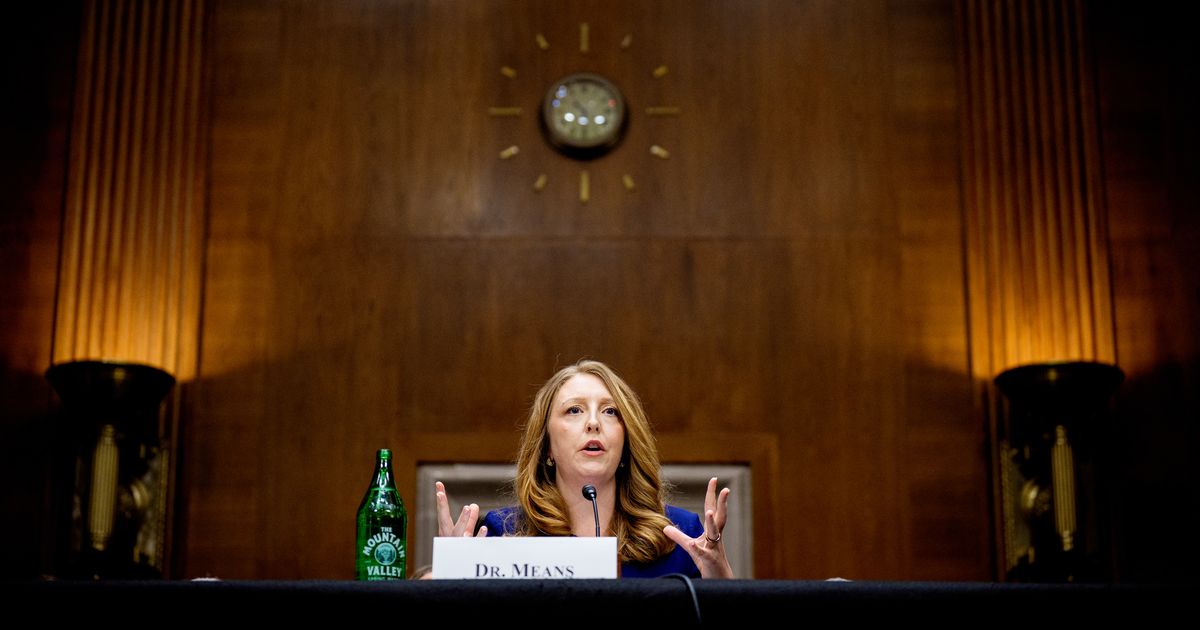
It was late February when Dr. Casey Means, a wellness influencer and a key figure in the “Make America Healthy Again” movement, sat before the Senate Health, Education, Labor and Pensions Committee, the bipartisan panel whose approval she needs before her nomination heads before the full chamber for a vote. For hours, Means was grilled about her stances on vaccines and birth control as well as financial deals she’s made with supplement and wellness companies, investments that she’s vowed to divest from if confirmed.
But as March draws to a close, Means’s nomination has languished in the Senate with speculation growing that she lacks votes from the HELP Committee to advance. Trump was asked about the possibility of withdrawing Means’s nomination during a press gaggle aboard Air Force One on Sunday. The president notably didn’t rule out the possibility of putting a new candidate forward. “Well, we’re looking at a lot of different things. I don’t know how she’s doing in the nomination process. I’m more focused on Iran, but something like that would be possible,” he told reporters. “We certainly have a lot of great candidates for that job.”
By Monday, the White House issued an official statement backing Means’s nomination and urging the Senate to move forward with her nomination. “Dr. Casey Means has spent her entire career as an entrepreneur, bestselling author, and researcher bringing attention to America’s chronic disease epidemic and how our healthcare system is failing the American people,” White House press secretary Karoline Leavitt said in a statement to NBC News. “The President stands by her and the Senate should move to quickly [confirm] Dr. Means as our next surgeon general without further delay.”
Means is Trump’s second nominee for the surgeon-general role. Last May, the president pulled his nomination of Dr. Janette Nesheiwat, a former Fox News health contributor, ahead of her Senate hearing. He then announced his selection of Means, whose initial hearing in October was postponed after she went into labor.
For Means to advance, she can’t afford to lose the vote of any of the HELP Committee’s Republican members. But at least three have signaled reservations about her nomination. In one exchange with HELP Committee chairman Bill Cassidy, a crucial Republican vote and physician, the senator asked Means if she believed that vaccines have caused autism. Means said she accepted evidence that there are no links between autism and vaccination but said that science “isn’t settled.”
“We do not know as a medical community what causes autism,” she said. “Until we have a clear understanding of why kids are developing this at higher rates, I think we should not leave any stones unturned.”
Cassidy, who has been a strong critic of public-health policy shifts undertaken by Health and Human Services secretary Robert F. Kennedy Jr., has not signaled how might vote on Means, telling NBC News, “No comment on Casey” last Thursday. The Associated Press reports that Senator Lisa Murkowski of Alaska and Senator Susan Collins of Maine remain undecided following last month’s hearing where both Republicans heavily questioned Means.
Means’s nomination has been criticized by several people who have held the position she is currently seeking. Jerome Adams, who served as surgeon general during Trump’s first term, voiced his opposition in an editorial for STAT News. Adams pointed to Means’s inactive medical license, suggesting it would be hypocritical for her to hold the role as the surgeon general is tasked with leading the United States Public Health Service Commissioned Corps, which requires its officers to have an active license. The former Trump official also noted Means’s hesitancy to endorse vaccines during her confirmation hearing as well as the potential for conflicts of interest from her investments in medical and wellness companies, writing that the surgeon general “is not a wellness influencer.”
“The surgeon general should be someone who can stand in operating rooms and emergency departments with credibility, and who understands both bedside medicine and public health. Confirming a nominee who does not practice medicine would diminish the office, weaken morale within the Corps, and signal that political loyalty outweighs professional standards,” Adams said.
Rich Carmona, who served as surgeon general under former president George W. Bush, also questioned Means’s qualifications for the role. “Leadership in the Public Health Service must remain merit-based and above politics. Appointing a nominee who lacks the credentials expected of even entry-level officers in the corps threatens the credibility of this proud institution,” he wrote in an op-ed for The Hill.
Casey Means May Be Too Kooky Even for Republicans