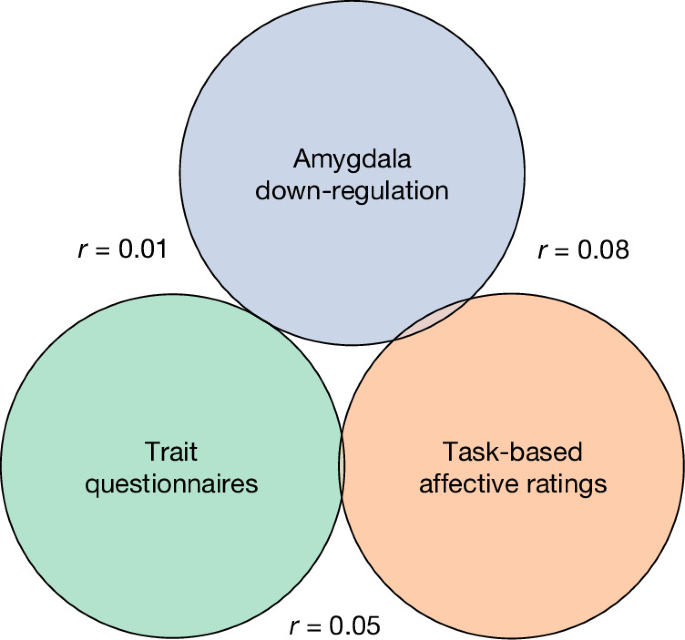
Cognitive reappraisal refers to changing how one thinks about a situation to alter its emotional impact. It is central to well-being1 and engages prefrontal regulatory circuits2, prompting the assumption that their activity reflects a person’s capacity to regulate emotions3–5. Yet evidence for this assumption remains inconclusive and has not been established at scale. Here we analysed 40 task-based functional magnetic resonance imaging (fMRI) datasets in a preregistered consortium with 2,175 participants and show that three widely used indicators of reappraisal capacity—trait questionnaires, task-based affective ratings and amygdala down-regulation—do not converge on a common core. Moreover, none of the three indicators showed the expected association with canonical prefrontal regulatory circuits. Trait questionnaires showed no detectable neural associations across the brain and task-based affective ratings were instead associated with responses in the amygdala and sensorimotor cortices. At the process level, canonical control circuits were engaged during both emotion generation and reappraisal, challenging their presumed specificity for emotion regulation. These findings caution against using activation in putatively regulatory brain regions to infer how well a person regulates emotions, with implications for neural biomarkers, interventions and psychoeducation that link emotion regulation difficulties to specific regional brain deficits. Sensorimotor and amygdala activation, but not canonical prefrontal control circuits, indicate emotion regulation capacity.