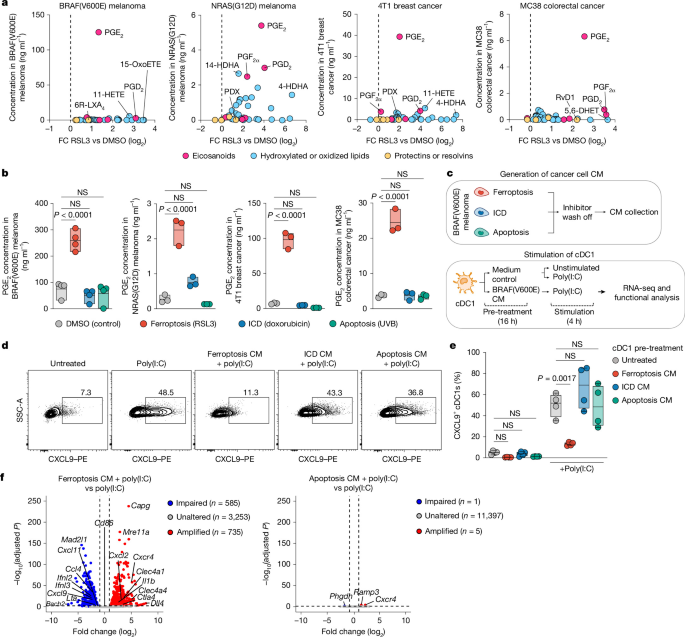
Ferroptosis, a form of cell death induced by overwhelming membrane lipid peroxidation, is a vulnerability of many cancers, including cancers resistant to current molecular and immune-based therapies1–7. Triggering of ferroptosis therefore provides an opportunity to achieve elimination of difficult-to-treat cancers1–4,8,9. Studies in mouse cancer models have demonstrated that anticancer immunity, mediated by dendritic cells (DCs) and CD8+ T cells, is essential for effective tumour eradication by ferroptosis-inducing strategies10–13. However, ferroptotic cells limit this response8–10,14, resulting in immune escape and tumour growth through mechanisms that remain unclear. Here we demonstrate that ferroptotic cancer cells activate a molecular program resulting in aberrant production of prostaglandin E2 (PGE2), which limits the stimulation of anticancer CD8+ T cell responses by type 1 conventional DCs (cDC1s), thereby promoting immune escape. In ferroptotic cancer cells, lipid peroxidation-mediated membrane permeabilization enables Ca2+ influx, which activates p38 MAPK signalling and thereby drives PGE2 production. This signalling axis is uncoupled from cancer cell death and can be targeted to selectively interfere with immune-inhibitory PGE2 production while preserving ferroptotic cancer cell elimination. In the context of cancer cell ferroptosis, ablation of PGE2 production or disrupting PGE2 signalling restores cDC1-mediated anticancer CD8+ T cell responses and leads to effective tumour elimination. Our findings identify a key mechanism that limits antitumour immunity and prevents tumour elimination upon ferroptosis induction in cancer cells, which could be exploited for cancer therapy. Ferroptotic cancer cells activate a molecular program that causes increased levels of PGE2, which in turn impairs type 1 conventional dendritic cell function, compromising antitumour CD8+ T cell immunity.