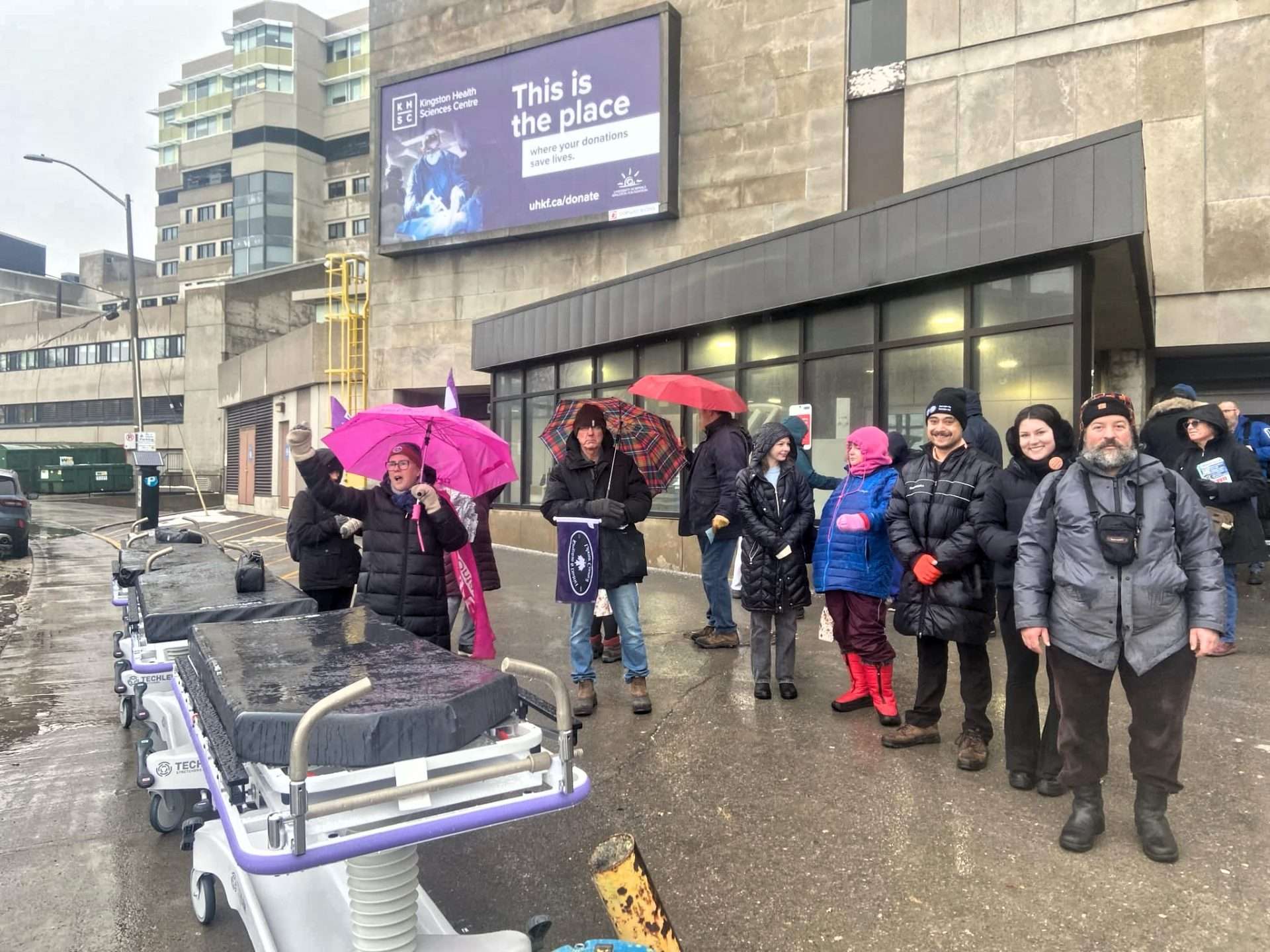
Hospital workers with the Ontario Council of Hospital Unions (OCHU) of the Canadian Union of Public Employees (CUPE) stand outside Kingston General Hospital (KGH) on King Street West in the cold rain of Monday, Feb. 3, 2025, to draw attention to the “crisis” they point to in terms of wait times and bed shortages at hospitals throughout Ontario, such as those within Kingston Health Sciences Centre (KHSC), like KGH. Photo by Kingstonist.
On the afternoon of Monday, Feb. 3, 2025, a lineup of hospital stretchers were on view outside of Kingston General Hospital (KGH) to symbolize the crisis in Ontario’s health care, according to a provincial union.
The demonstration was staged by the Ontario Council of Hospital Unions (OCHU) of the Canadian Union of Public Employees (CUPE). The hospital workers’ union issued a media release ahead the Monday afternoon demonstration, which began at 3 p.m., pointing to the following ways they say the province is failing its residents:
1,860 people on stretchers in hospital hallways, up from 826 in June 2018 when the Premier promised to end hallway medicine
2.5 million citizens without a family doctor
Palliative homecare patients dying without painkillers and medical supplies
250,000 people waiting for surgeries, 11,000 of whom died on the waitlist
Nearly 50,000 people waiting for long-term care
Constant ER closures in small towns
“The crisis in healthcare affects almost every family,” said Michael Hurley, President of OCHU-CUPE.
“The entire health care sector is staggering. There is no end to the staffing shortages; ER closures, waits for surgeries or for long-term care beds or for a family doctor or for appropriate home care services. We hope to help ensure that this election focuses on solutions to this crisis.”
Union colours and flags were visible behind the rain-soaked hospital beds outside KGH that the OCHU-CUPE says are much needed inside the hospital. Photo by Kingstonist.
According to the release, Kingston Health Sciences Centre (KHSC) is running at 93.7 per cent capacity, well above the 85 per cent recommended maximum bed occupancy level. An analysis done by OCHU-CUPE, shows that KHSC must add 56 beds to achieve safe occupancy levels, the union stated.
OCHU-CUPE also said that the latest data for KGH shows that ER patients wait, on average, 21 hours to be admitted, with only 18 per cent of them admitted within the target time of eight hours.
In the release, the union is raising concerns about access to care due to growing deficits across the hospital sector. Based on latest data, hospitals in Ontario faced a cumulative shortfall of $800 million in the first half of 2024-25, according to OCHU-CUPE. At KHSC, the shortfall was $12.5 million, the union said.
Pointing out that per-person hospital funding in Ontario is the lowest in Canada and that the province has the fewest beds and hospital staff to population, Hurley said it is not surprising to witness a record increase in hospital overcrowding. About 2,000 patients every day receive care on stretchers in unconventional spaces such as hallways and storage closets, an increase of 125 per cent since June 2018 when Ford got elected on the promise to end hallway health care, according to the release.
Hurley said hospital overcrowding compromises patient and staff safety, causing delays in admitting patients, higher risk of nosocomial (hospital-acquired) infections, and heavier workloads. Moreover, it robs patients of dignity as they are treated out in hallways without privacy, the union president expressed.
“There are 250,000 people on wait lists for surgeries and 11,000 of them died waiting last year,” he stated. “2,000 are on stretchers today, begging for a bed. Palliative patients die at home without painkillers. As a province we must do so much better for our citizens.”
In the release, the union recommends the following solutions to “address the health care crisis:”
Improve hospital capacity to match the needs of an ageing and growing population, by adding staffed hospital beds.
Address the staffing crisis by improving compensation and working conditions, and providing incentives such as free tuition to students in nursing and PSW programs
End private sector delivery of acute, long-term care and community health services
Ban agency nurses to reduce staffing costs, and invest that money in improving compensation and working conditions for in-house workers
Improving staffing in LTC to meet the 4-hours of daily care benchmark and expand capacity to reduce waitlist
End contracting out of services across health care, and run LTC and home care on a public, not-for-profit basis
Expand the use of nurse practitioners to lead primary care clinics
Kingstonist reached out to KHSC — the health-care administration organization that oversees the operations of a number of Kingston hospitals, including KGH, Hotel Dieu Hospital, and the Cancer Centre of South Eastern Ontario — shortly after the union demonstration began (3:12 p.m. on Monday, Feb. 3, 2025). Confirmation of the individual assertions made by OCHU-CUPE was requested, as well as response from the organization to the message the union was emphasizing. No response was received by time of publication.
Further coverage of this matter will be provide if/when more information becomes available.
Members of the local branch of the Ontario New Democratic Party (NDP) joined the OCHU-CUPE workers at the demonstration on Monday, Feb. 3, 2025, including Elliot Goodale Uglade, the NPD nominee for Kingston and the Islands in the upcoming provincial election. Photo by Kingstonist.
With files from Tori Stafford.
Hospital union lines up gurneys outside KGH to draw attention to health-care ‘crisis’