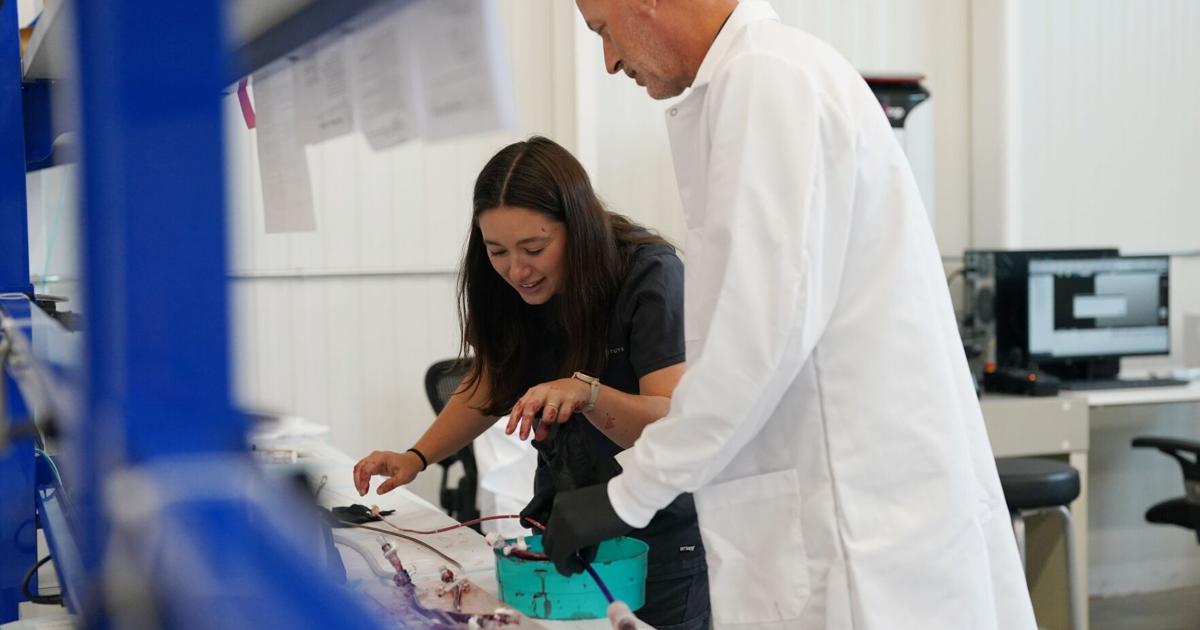
Inside a red, triangular-roofed building on the Northland Corridor, Vicora Inc. CEO Shawn Patterson and Director of Engineering Erin Garcia are busy testing the company’s innovative catheter system that could boost efforts to build a medical device hub in Buffalo.
Here, on an afternoon in late August, they feed Vicora’s Vibrato catheter into a model used for simulations that is filled with animal blood, mimicking what it would look like for a physician to snake the device through a patient’s upper legs on the meandering path to suck out blood clots.
What makes this still-under-development catheter different – and why it represents a big opportunity for Buffalo – is an electroactive polymer at its tip, which vibrates at different frequencies.
The device’s distal tip vibration is designed to break up and help remove difficult clots, which can clog catheters currently on the market. The company hopes to shake up the $10 billion annual market for vascular intervention.
The executives behind the company have still larger ambitions: They hope the product will help supercharge a business ecosystem for medical device innovation in Buffalo.
While that goal may sound lofty, it feels attainable to the team at Buffalo-based Egret Healthcare Ventures, which invests in medical technologies and now has three companies in its portfolio: Vicora, Ampullae and The Rookery Labs, the last of which serves as a business incubator that provides the facilities, expertise and services that early-stage companies need to progress to clinical use.
Bill Maggio, co-founder and chairman of Egret, said he’s been inspired by the work of clinicians and researchers at University at Buffalo, the Jacobs Institute and Gates Vascular Institute. As the former CEO of the Jacobs Institute and former vice chair of Kaleida Health’s Board of Directors, he saw the opportunity to complement existing efforts and bring in more medical device innovation to the region.
“I think there’s just so much more potential,” he said. “We’re just trying to push the envelope a little bit, and I’m entirely confident that 10 years from now, there’s going to be a number of medical device companies that have spun out of Buffalo. I believe it.”
Buffalo has a healthy presence of companies that manufacture components for medical devices, but not as many firms that develop complete medical devices, which involves taking an idea and creating an entire device that finds its way to the shelf at a hospital or doctor’s office.
In Vicora, Egret sees a rare opportunity for the region to produce a finished medical device, meaning it was designed, developed and commercialized in Buffalo. Buffalo has a notable history in this arena, dating to the invention of the implantable pacemaker by Wilson Greatbatch about seven decades ago.
In its young history, Vicora has tapped into the region’s resources. It spent over a year in the Jacobs Institute’s Idea to Reality Center doing initial design work, received $300,000 from UB’s Center for Advanced Technology in Big Data and Health Sciences and also formed an active clinical advisory team that includes UBMD and Gates Vascular Institute interventional cardiologists Dr. Chris Manion and Dr. David Zlotnick.
Vicora officials believe their device that could advance treatment options for deep vein thrombosis (a blood clot that forms in a deep vein, usually in the leg) and pulmonary embolism, a condition where a blood clot migrates to block arteries in the lungs.
Egret in May completed a $3.6 million funding round for Vicora, and the Vicora team is now deep into the extensive and laborious process of performing the testing required to obtain regulatory approvals. In early 2026, the company plans to begin the Food and Drug Administration approval process. Vicora, working with partners in Europe, also plans a human study next year for treating pulmonary embolisms.
Vicora Inc. plans to use a $3.6 million funding round to complete the design, development, manufacturing and testing required to obtain regulatory approvals toward commercializing robotic catheters that remove blood clots from the legs, lungs and brain.
For Rick Ducharme, the former vice president of engineering at the Jacobs Institute who came up with the ideas for what became Vicora and Ampullae, it’s been a long journey to get here.
Ducharme said Vicora and Ampullae are both built on the concept of using thin, flexible smart materials to make traditional catheters and medical devices “intelligent,” helping physicians and also improving outcomes for patients. He expects Vicora’s technology to shine in procedures that involve “the really tortuous twists and turns when you need to go up into the lungs and treat those patients.”
“It almost doesn’t feel real that we’ll be treating patients next year,” said Ducharme, one of Egret’s five co-founders and the chief scientific officer. “And there’s still nothing like this out there.”
Building the team
Maggio has been a mainstay in Buffalo’s entrepreneurial scene for 25 years, including his involvement with the Jacobs Institute and the 43North accelerator program.
While Buffalo has made major strides in cultivating startups and recruiting companies here, Maggio said there has been a void in companies focused on developing finished medical devices applying to 43North.
“The whole thesis behind starting Egret was to create some sort of entrepreneurial momentum around getting people to believe they could build and create companies in Buffalo around medical devices,” Maggio said.
Egret was founded in 2020 with five co-founders with diverse skill sets: Maggio; biopharmaceutical and medical technology industry veteran Matt Colpoys; Mike Hughes, a former Kaleida Health executive well-versed in government affairs and communications; longtime attorney and Lippes Mathias partner Brian Bocketti; and Ducharme, who worked at the Jacobs Institute while Maggio was CEO and had experience with technology that could create sensations of touch and vibration through his prior work with a company called Novasentis.
Vicora and Ampullae – a company that uses a flexible sensor to indicate how much force is being applied to the end of an endovascular device – became Egret’s first portfolio companies.
In late 2024, Egret founded its third company: The Rookery Labs.
The Rookery, located on the Northland Corridor in the red building that formerly housed Garwood Medical, serves as an innovation incubator for medical device research and development.
Once The Rookery launched, the incubator already had its first two companies to focus on: Vicora and Ampullae.
To get here, Egret recruited talent to Buffalo.
That included recruiting Western New York native Shawn Patterson in June 2024 to serve as CEO of Vicora and Ampullae. Patterson, who went to UB for chemical engineering, got an internship out of school at Wilson Greatbatch Technologies and then was relocated to Minnesota when the firm acquired two companies there. Patterson eventually co-founded a medical device company in Minnesota, leading the firm for 12 years before returning to Western New York.
Patterson also knew Blane Larson, a North Dakota native he worked with in Minnesota. Larson came to Buffalo to become CEO of The Rookery Labs. Together, Larson and Patterson bring their expertise and experience from Minnesota, home to nearly 530 medical device companies that employ more than 34,000 people.
“What Blane and I are bringing is that knowledge and then that network of people, service providers,” said Patterson, who became the sixth Egret partner.
What’s being built in Buffalo is what brought Erin Garcia back home.
Garcia, a Grand Island native, went to college at Worchester Polytechnic Institute and then received her master’s degree at Cornell University in biomedical engineering. When she finished school, she couldn’t find a job in Western New York in the medical device field. She ended up moving to Colorado, where she worked for Nissha Medical Technologies. While Nissha is headquartered in Buffalo, Garcia said the research and development operations are in Colorado.
After three years at Nissha and two years at Philips Healthcare, also in Colorado, Garcia joined Egret, where she is a senior associate, and Vicora, where she is director of engineering, in January 2023. Nearly three years later, Garcia is busy testing Vicora’s device and helping to get documentation prepared for FDA submission.
With more medical device development in Buffalo, Garcia said she believes it could help keep talent in Western New York.
“I think it’ll allow people to be engaged in that early upfront design and also all the way through commercialization, so you can really kind of pick where you want to be and then learn a bunch along the way,” she said.
Setting the stage
In Minnesota, Patterson and Larson were part of a startup culture, where competitors in the medical device field still collaborated with one another. That’s what they hope to help build in Buffalo.
And, they say, they have had interest from outside talent and companies to relocate here.
“We’ve got three to five other companies that want to come here and work with us,” Larson said.
With Vicora, the team will be busy the rest of this year and early next year with testing, studies and regulatory submissions.
At some point, Vicora may attract a larger company interested in purchasing it. But it’s also possible Vicora could further develop as a company right in Buffalo.
The way the model works is: Any wealth generated from the companies will be reinvested to help support the next Egret portfolio company, which will use The Rookery’s equipment, facilities and expertise to try to develop a medical device.
From that, its builders hope, an ecosystem could be born.
Jon Harris can be reached at 716-849-3482 or jharris@buffnews.com. Follow him on X at @ByJonHarris.
The business news you need
Get the latest local business news delivered FREE to your inbox weekly.
* I understand and agree that registration on or use of this site constitutes agreement to its user agreement and privacy policy.
Jon Harris
Health care reporter
Get email notifications on {{subject}} daily!
Your notification has been saved.
There was a problem saving your notification.
{{description}}
Email notifications are only sent once a day, and only if there are new matching items.
Followed notifications
Please log in to use this feature
Log In
Don’t have an account? Sign Up Today
How to make Buffalo a hub for medical device innovation