To place an obituary, please include the information from the obituary checklist below in an email to obits@pioneerpress.com. There is no option to place them through our website at this time. Feel free to contact our obituary desk at 651-228-5263 with any questions.
General Information:
Your full name,
Address (City, State, Zip Code),
Phone number,
And an alternate phone number (if any)
Obituary Specification:
Name of Deceased,
Obituary Text,
A photo in a JPEG or PDF file is preferable, TIF and other files are accepted, we will contact you if there are any issues with the photo.
Ad Run dates
There is a discount for running more than one day, but this must be scheduled on the first run date to apply.
If a photo is used, it must be used for both days for the discount to apply, contact us for more information.
Policies:
Verification of Death:
In order to publish obituaries a name and phone number of funeral home/cremation society is required. We must contact the funeral home/cremation society handling the arrangements during their business hours to verify the death. If the body of the deceased has been donated to the University of Minnesota Anatomy Bequest Program, or a similar program, their phone number is required for verification.
Please allow enough time to contact them especially during their limited weekend hours.
A death certificate is also acceptable for this purpose but only one of these two options are necessary.
Guestbook and Outside Websites:
We are not allowed to reference other media sources with a guestbook or an obituary placed elsewhere when placing an obituary in print and online. We may place a website for a funeral home or a family email for contact instead; contact us with any questions regarding this matter.
Obituary Process:
Once your submission is completed, we will fax or email a proof for review prior to publication in the newspaper. This proof includes price and days the notice is scheduled to appear.
Please review the proof carefully. We must be notified of errors or changes before the notice appears in the Pioneer Press based on each day’s deadlines.
After publication, we will not be responsible for errors that may occur after final proofing.
Online:
Changes to an online obituary can be handled through the obituary desk. Call us with further questions.
Payment Procedure:
Pre-payment is required for all obituary notices prior to publication by the deadline specified below in our deadline schedule. Please call 651-228-5263 with your payment information after you have received the proof and approved its contents.
Credit Card: Payment accepted by phone only due to PCI (Payment Card Industry) regulations
EFT: Check by phone. Please provide your routing number and account number.
Rates:
The minimum charge is $162 for the first 12 lines.
Every line after the first 12 is $12.
If the ad is under 12 lines it will be charged the minimum rate of $162.
Obituaries including more than 40 lines will receive a 7.5% discount per line.
On a second run date, receive a 20% discount off both the first and second placement.
Place three obituaries and the third placement will be free of charge.
Each photo published is $125 per day. For example: 2 photos in the paper on 2 days would be 4 photo charges at $500.
Deadlines:
Please follow deadline times to ensure your obituary is published on the day requested.
Hours
Deadline (no exceptions)
Ad
Photos
MEMORIAM (NON-OBITUARY) REQUEST
Unlike an obituary, Memoriam submissions are remembrances of a loved one who has passed. The rates for a memoriam differ from obituaries.
Please call or email us for more memoriam information
Please call 651-228-5280 for more information.
HOURS: Monday – Friday 8:00AM – 5:00PM (CLOSED WEEKENDS and HOLIDAYS)
Please submit your memoriam ad to memoriams@pioneerpress.com or call 651-228-5280.
By STEPHEN WADE
The figure skaters at the Winter Olympics make it look easy; sheer elegance on hard ice.
But elite skaters also fight injuries, much like the rest of us who work out, go to the gym or swim to stay fit.
“No athlete at this level is 100% fully healthy,” Gretchen Mohney, the director of medical and performance services for U.S. Figure Skating, told The Associated Press from Milan. “It’s about managing whatever it is that may be breaking down.”
The key for Olympic skaters is getting quick treatment. If a knee swells, the back aches or a sharp blade leaves a gash, figure skaters at the Olympics have physicians, athletic trainers and physical therapists to help.
Mohney, who holds a doctorate in interdisciplinary health sciences, listed several red flags that skaters and staff watch for, and wellness tips for weekend athletes.
Some warning flags
Treat acute injuries immediately. “Recognizing and responding to acute injury is huge and what we are going to do about it versus ignoring it, because it usually gets worse,” Mohney said. “You have to get rid of the old-school philosophy of just suck it up and don’t do anything about it.”
Treatment of chronic injuries. Elite figure skaters can’t take six weeks off, and at the Olympics, it’s perform now or never. “We don’t say rest for two weeks, we say let’s get you to perform as safely as possible … without causing further injury,” Mohney said. Some interventions are simple, like adding padding to the feet to offset small friction inside the skate.
Loss of mobility and compensation. Stretching and warmups are critical. “When we lose mobility or flexibility our bodies start to compensate and the stress is put on another part,” Mohney explained. For figure skaters that could mean “the difference between doing a double jump and a quadruple jump.”
Dealing with overuse. Mohney says vary the volume and intensity of training. Skaters compete year round. She used the example of skaters arching their back repeatedly to do layback spins. “You are going to have back pain no matter who you are,” she said. “All of our athletes vary their training. You want to make sure you are changing your load so the body can recover.”
‘The hard ice always wins’
Dr. Fred Workman has been a team physician for U.S. Figure Skating for 25 years, and lately he’s treating more concussions. This might surprise some who see only the elegance, but figure skating has been pushing the limits of performance, and there’s fallout.
Other frequent injuries include lacerations from knife-edge skates, or hip, knee, ankle and foot injuries — and shoulder injuries for men lifting partners overhead in the pairs event.
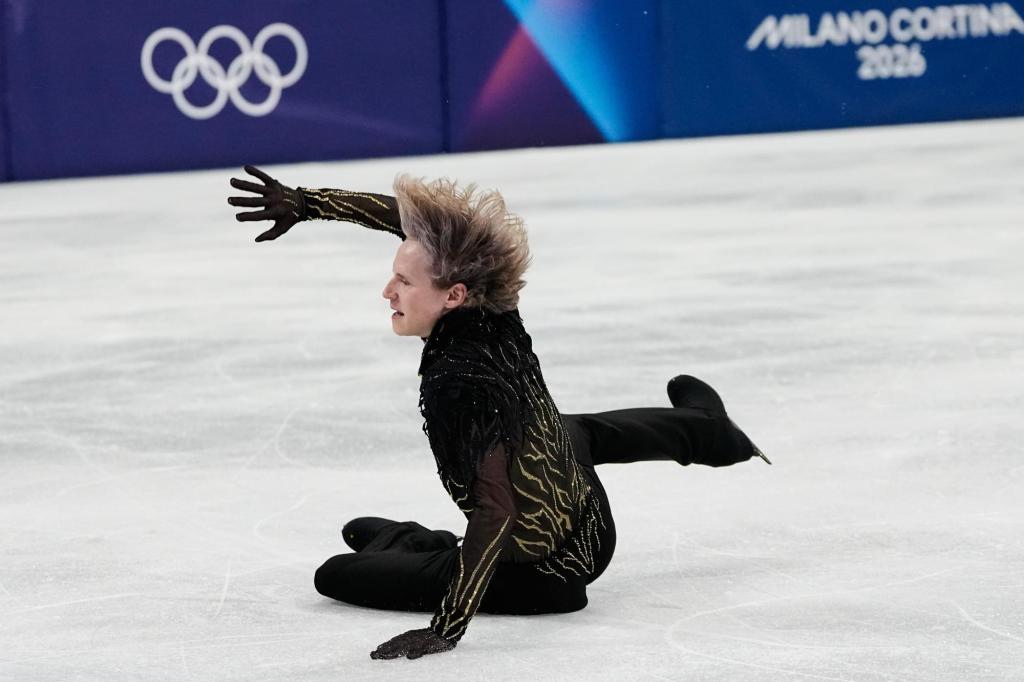
“They’re doing overhead lifts, spinning around on the ice — and smiling,” Workman said. “Skaters are doing much more demanding and aggressive — risky if you will — maneuvers. The hard ice always wins. When you fall on the ice, something is going to give.”
Part of Workman’s job is diagnosis and treatment. The other is a holistic approach to guiding young athletes. This also includes managing stress and mental health.
“Life doesn’t always go your way,” Workman said. “We’re in a judged sport. You may not always get the scores you think you deserve. But how do you handle it? You have to get yourself mentally focused and be ready to perform.”
Ilia Malinin’s two falls last week in Milan remind of the pressure elite skaters face. Malinin described feeling overwhelmed. “I just felt like I had no control,” he said.
Away from competition, Workman asks skaters to add variety to their training — and to their life.
“Not only cross-train in your sport, but cross-train as a human,” he said. “Diversify your interests. A very common mistake is spending all of your time on the ice and less time in off-the-ice training.”
Workman suggested a wider view, even for elite athletes at the Olympic level. He referenced a television ad the NCAA ran several years ago, which reminded college athletes that their life is now sports — but it won’t always be.
“At the end of the day, competitive careers end,” Workman said. “Why do we even have sport? It’s to build resilience, to build the life skills you need.”
Concussions, comebacks
The American pairs team of Ellie Kam and Danny O’Shea knows about injury. Last year, Kam was out for a month with a concussion and O’Shea needed foot surgery.
Unexpectedly, they put on one of the best performances of their lives to help the United States win its second straight Olympic gold medal in the team event.
“We just wanted to kind of give it our all, and I feel like that’s part of the reason why Danny and I have been able to work through so much of what people would see as obstacles,” Kam said. “I think in the obstacles we found a way to connect better and be a stronger team.”
Deanna Stellato-Dudek, an American-born Canadian pairs skater at the Olympics, hit her head on the ice in a training session on Jan. 30. The 42-year-old Stellato-Dudek and partner Maxime Deschamps had to withdraw from the team event during the first week of the Olympics.
“You have to take extremely specific care of your body,” she told The AP. “I don’t smoke, I don’t drink, I’m extremely healthy. And I do think being able to treat my body like that for the last decade has helped me to heal very quickly.”
AP sportswriter Dave Skretta contributed from Milan.
Follow AP’s Be Well coverage, focusing on all aspects of wellness, at https://apnews.com/hub/be-well
Olympic figure skaters offer wellness tips for weekend athletes. The ‘hard ice always wins’