To place an obituary, please include the information from the obituary checklist below in an email to obits@pioneerpress.com. There is no option to place them through our website at this time. Feel free to contact our obituary desk at 651-228-5263 with any questions.
General Information:
Your full name,
Address (City, State, Zip Code),
Phone number,
And an alternate phone number (if any)
Obituary Specification:
Name of Deceased,
Obituary Text,
A photo in a JPEG or PDF file is preferable, TIF and other files are accepted, we will contact you if there are any issues with the photo.
Ad Run dates
There is a discount for running more than one day, but this must be scheduled on the first run date to apply.
If a photo is used, it must be used for both days for the discount to apply, contact us for more information.
Policies:
Verification of Death:
In order to publish obituaries a name and phone number of funeral home/cremation society is required. We must contact the funeral home/cremation society handling the arrangements during their business hours to verify the death. If the body of the deceased has been donated to the University of Minnesota Anatomy Bequest Program, or a similar program, their phone number is required for verification.
Please allow enough time to contact them especially during their limited weekend hours.
A death certificate is also acceptable for this purpose but only one of these two options are necessary.
Guestbook and Outside Websites:
We are not allowed to reference other media sources with a guestbook or an obituary placed elsewhere when placing an obituary in print and online. We may place a website for a funeral home or a family email for contact instead; contact us with any questions regarding this matter.
Obituary Process:
Once your submission is completed, we will fax or email a proof for review prior to publication in the newspaper. This proof includes price and days the notice is scheduled to appear.
Please review the proof carefully. We must be notified of errors or changes before the notice appears in the Pioneer Press based on each day’s deadlines.
After publication, we will not be responsible for errors that may occur after final proofing.
Online:
Changes to an online obituary can be handled through the obituary desk. Call us with further questions.
Payment Procedure:
Pre-payment is required for all obituary notices prior to publication by the deadline specified below in our deadline schedule. Please call 651-228-5263 with your payment information after you have received the proof and approved its contents.
Credit Card: Payment accepted by phone only due to PCI (Payment Card Industry) regulations
EFT: Check by phone. Please provide your routing number and account number.
Rates:
The minimum charge is $162 for the first 12 lines.
Every line after the first 12 is $12.
If the ad is under 12 lines it will be charged the minimum rate of $162.
Obituaries including more than 40 lines will receive a 7.5% discount per line.
On a second run date, receive a 20% discount off both the first and second placement.
Place three obituaries and the third placement will be free of charge.
Each photo published is $125 per day. For example: 2 photos in the paper on 2 days would be 4 photo charges at $500.
Deadlines:
Please follow deadline times to ensure your obituary is published on the day requested.
Hours
Deadline (no exceptions)
Ad
Photos
MEMORIAM (NON-OBITUARY) REQUEST
Unlike an obituary, Memoriam submissions are remembrances of a loved one who has passed. The rates for a memoriam differ from obituaries.
Please call or email us for more memoriam information
Please call 651-228-5280 for more information.
HOURS: Monday – Friday 8:00AM – 5:00PM (CLOSED WEEKENDS and HOLIDAYS)
Please submit your memoriam ad to memoriams@pioneerpress.com or call 651-228-5280.
The sound of bagpipes still makes Butch Inks feel sick to his stomach.
It brings him back to seven funerals of active-duty firefighters when he was St. Paul’s assistant fire chief and then fire chief.
Those were the worst days of his career, said Inks, who retired Tuesday after 31 years as a St. Paul firefighter.
Firefighters are impacted at higher rates than the general population for cardiac disease, cancer and post-traumatic stress disorder. As chief, Inks focused on the health of St. Paul firefighters. He brought about comprehensive cardiac and cancer screenings, reestablished a full-time health and wellness coordinator, and started a peer support team.
Most people think of firefighters as running into burning buildings to save lives and extinguish flames — “and we do that a lot,” Inks said — but more than 80 percent of the work of St. Paul firefighters is emergency medical responses. The city’s firefighters are all emergency medical technicians and many are also paramedics.
“The EMS calls, day-to-day, wear and tear on the mental capacity and emotions of a human being,” said Inks, who recalled as a fire captain when he delivered a baby one morning and, later the same day, responded to a call a block away of a baby not breathing; the child had been beaten.
‘It’s OK to not be OK’
Inks, 57, said he was “from an era where you didn’t speak up” about your feelings. Even five years ago, Inks said he would still tell people, “I’m fine.”
“It was the wrong approach,” he said. “I think we’ve shifted the culture to, ‘It’s OK to not be OK.’”
He now tells fellow firefighters that he talks to a therapist about the traumas he witnessed up close as a first responder. He spoke to recruit classes and firefighters at stations about the importance of not keeping their memories and emotions bottled up. By being open about his own experiences, he wants to help others.
“I can be very intentional because on my very first day on the street after I finished the fire academy, we went to a call of a woman who was having a heart attack,” said Inks, who remembered that she died as he gave her CPR.
Back at the station, where firefighters in St. Paul prepare meals during their 24-hour shifts, “someone was like, ‘pass the ketchup,’” Inks said. As a young man, Inks thought, “What is going on here? Somebody just died.”
“You can’t hold this in because I’ll tell you what’s going to happen: You’re going to drink excessively, you’re going to get divorced — if you get married at all — you’re going to have relationship problems,” Inks said. “The job will disrupt your life if you don’t recognize that what you’re seeing and experiencing was not normal. You have to have a way to process that.”
Inks will be the next executive director of the Minnesota Fire Service Certification Board, and he plans to bring his message of physical and mental wellness for new firefighters into that role.
Started working for city at age 15
Being fire chief was challenging: “It’s managing people, feelings, expectations; it’s holding employees accountable,” said Inks, adding that his wife, Erica, was the only other person who understood how much time went into each of his decisions.
“You have to be able to talk through every decision you make, and we all benefit from another point of view,” Erica Inks said. “We’ve joked about this before — I am probably the person in his life who can tell him most honestly if I don’t agree with him.”
Inks said he didn’t expect that being chief would also be tough on his wife and four children, two of whom are now teenagers and two in their 30s. He slept with his cellphone next to him, at the ready to respond if there was a major fire or large-scale incident in St. Paul.
Still, Inks said it was an honor “to be a public servant for so long, and in the city I grew up in, in the city I love.”
Inks was raised on Stinson Street across from the Front Recreation Center in the North End.
He played hockey at the outdoor ice rink across the street from his house and was a right wing on the Como Park High School hockey team, along with playing football and baseball.
His first job was at the Front Rec Center when he was 15. By 16, he had a key to the building and became a recreation aide. He never stopped working for the city of St. Paul.
‘Aggressive but cautious’ firefighter rose through the ranks
When Inks joined the fire department in 1994, Dan Berger was his first captain on Rescue Squad 1 at Station 4 on Payne Avenue near East Seventh Street.
“He was very dependable right away and reliable,” said Berger, who is now retired. “He was aggressive but cautious — good traits to have in the fire business.”
Berger saw Inks’ motivation and said “he pursued endless training” both through the fire department and the Air Force Reserve, where Inks served for 26 years, most of the time as a firefighter. Berger said he expected Inks would get promoted through the ranks.
Being physical as a firefighter took its toll on Inks, as it does on many firefighters. Shoulder, back and knee problems are common. When firefighters get called to an emergency, they might go from a conversation at their station to suddenly “doing manual labor,” said Inks, who needed various medical procedures for his knees throughout his career.
In 2011, there was a large apartment complex fire on Cushing Circle near Energy Park Drive and Lexington Parkway.
As a captain, Inks and other firefighters forced open apartment doors to make sure people were out and to get them to safety if they weren’t. An estimated 42 units were damaged, with no residents reporting injuries.
But he tore a muscle in his shoulder and received cortisone injections to relieve inflammation and pain over the years and his shoulder condition worsened.
He had shoulder replacement surgery in November. As he was recovering, Inks — who became fire chief in 2019, after serving as interim chief since 2018 — told Mayor Melvin Carter and then-Mayor-elect Kaohly Her that he would need to retire at the end of the year.
Inks is a licensed firefighter, which requires ongoing training, and he said he determined his shoulder could not withstand continued training without the risk of further injury.
Though Inks is no longer putting out fires, he said he believes St. Paul’s fire chief should be able to carry out all the duties of a firefighter.
“I ask them to put their life on the line and to do extraordinary things,” he said. “… As a leader, I don’t think I should be expecting them to do something I can’t do.”
Assistant Fire Chief Greg Duren was tapped to serve as interim fire chief and began on Wednesday.
Mayor Her “is committed to a fair and transparent process for determining the next fire chief,” a spokesperson said.
More staff, more calls
Before Inks told the fire department he was retiring, he pondered over how best to express “how appreciative I am of the work they have done.”
“Where this department was in 2018 to where it is now is an incredible shift,” Inks said. “We’ve asked a lot, we’ve changed a lot, and they’re the people that feel the change the most.”
Staffing is at its highest level in department history, Inks created new career and EMS pathways to get young people in the door, and he managed a 56 percent increase in calls for service over the last decade, the city council wrote in a resolution declaring Dec. 30 to be Chief Barton “Butch” Inks Day.
Inks said the biggest changes he oversaw also included:
Starting the Basic Life Support division. Before, Advanced Life Support was sent to every emergency medical call. Adding Basic Life Support resulted in speeding up emergency medical response times by almost one minute, Inks said, and created another entryway for people to become St. Paul firefighters.
Beginning CARES (Community Alternative Response Emergency Services), a two-person EMT alternative emergency response to nonviolent mental health crises and behavioral emergencies.
Overseeing the building of a new station to replace the old Station 7 in Dayton’s Bluff and reopening a shuttered station on West Seventh Street near downtown, bringing the stations in the city to 16. That’s allowed for more space for fire ladders, ambulances and engines — including the first electric engine in the state — to keep up with increasing call volume.
Securing grant funding for enhanced annual physicals for firefighters. “We used to get a general physical every year, and now he have a head-to-toe assessment,” Inks said. “They’ve identified some potential life-ending illnesses for folks who were able to catch it early and get treatment.”
At the beginning of the COVID-19 pandemic, Inks moved his office from fire department headquarters to the city’s Emergency Operations Center.
“I went from running the fire department to running a city-wide pandemic response,” Inks said. At the EOC, they coordinated finding food for kids and delivering meals, and processed St. Paul Bridge Fund applications for emergency relief for families and small businesses.
He also ran fire department operations from the EOC when civil unrest and fires erupted in St. Paul after George Floyd was killed in Minneapolis. He stayed at the center around the clock for three days.
The damage was bad, but Inks said it could have been worse. “We made sure it wasn’t by responding to every fire, every single time,” including smaller-scale fires like dumpsters.
Another sad goodbye
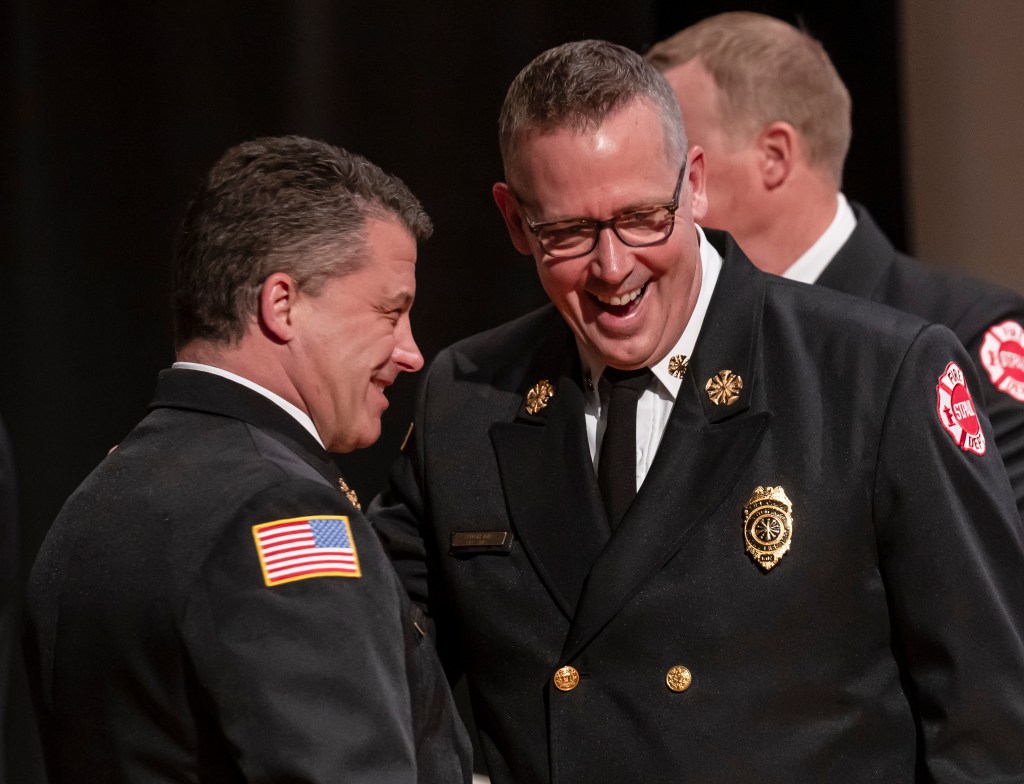
On Dec. 17, Inks gave the oath of office to the department’s 21 newest firefighters at their academy graduation.
Before Inks’ last time handing out St. Paul Fire Department badges, as he spoke to the audience of new firefighters’ family and friends, he looked at his wife sitting in the front. He saw Erica Inks was teary and he grew emotional as he spoke.
“While you begin your journey, I’m preparing to conclude mine,” he told the new firefighters. “I was once in those seats right there, 31 years ago. … I challenge you, that you don’t forget, that it is a job … but it’s bigger than that. It’s bigger than that to the people we serve. … You save people’s lives.”
Three days later, one of the new graduates, Timothy Bertz, had a sudden and major medical event at home. Bertz died at the hospital on Dec. 22. He was 52, and had been a firefighter in Harris in Chisago County and Lino Lakes.
On Inks’ second-to-last day of work, he found himself again feeling sick over the sound of bagpipes at a funeral because Bertz was another firefighter who lost his life too soon, Inks said.
The funerals he took part in as chief for several other firefighters were also medical emergencies. Two were firefighters who battled cancer and two were situations of suicide.
After wearing the department’s formal dress uniform at Bertz’s service Monday, Inks also donned it for his last day of work at the department on Tuesday. It was something he did throughout his tenure, at events that didn’t require him to dress up.
“In my mind, if I don’t, the only time I wear that uniform is when someone dies,” Inks said. “It has to mean more than only wearing it to that. I’m representing the people of our department, our city.”
St. Paul fire chiefs through the years
The list, based on the department’s 2010 yearbook, does not include interim or acting chiefs.
Butch Inks, 2019-2025
Tim Butler, 2007-2017
Douglas Holton, 2003-2007
Tim Fuller, 1991-2003
Steve Conroy, 1966-1991
Levi Shortridge, 1964-1966
Frank Oberg, 1958-1964
John Barry, 1957-1958
William Mattocks, 1949-1957
Ed Novak, 1948-1949
William Sudeith, 1934-1948
Owen Dunn, 1924-1934
Randall Niles, 1920-1924
Henry Devlin, 1914-1920
Randall Niles, 1913-1914
Jeremiah Strapp, 1905-1913
John Jackson, 1901-1905
Hart Cook, 1898-1901
John Jackson, 1889-1898
John Black, 1883-1889
R.O. Strong, 1876-1883
J.R. Prendergast, 1870
J.H. Hullsick, 1869
Frank Brewer, 1867-1868
Bartley Presley, 1866
Charles Williams, 1864-1865
Luther Eddy, 1863
B. Rodick, 1863
John Pickett, 1863
J.E. Missen, 1862
W.T. Donaldson, 1861
J.B. Irvine, a few months
Charles Williams, 1859-1860
St. Paul Fire Chief Butch Inks brings wellness message to new job