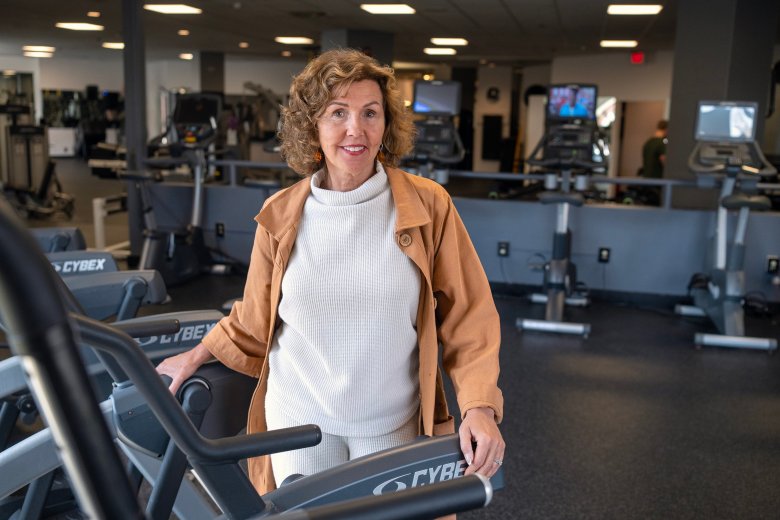
PORTLAND — Tracy Argondizza always thought she’d one day sell Bay Club Fitness as a featured tenant of One City Center and a valued downtown business.
Instead, she’s closing the 36-year-old gym and fitness studio at the end of May and consulting with a bankruptcy lawyer to help her find a way forward. She said she has struggled to rebuild membership that’s still down 40% from pre-pandemic numbers. And she can’t afford the rent increase her landlord wants after charging a significantly reduced rate since 2020.
Her decision to close has prompted outcry from club members and adds to the ongoing vacancy challenges facing the downtown corridor.
“We’re another collateral loss of the pandemic,” she said this week. “I never for a minute thought they’d want me completely out of here. I always thought they viewed the Bay Club as an amenity they’d want to preserve. So here I am, having to maneuver and figure out, how do I get out of here?”
Once a relationship-building, deal-making hub for the business community, the club has been battered by shifting trends coming out of the pandemic: more people are working from home in the suburbs and seeking nearby workout facilities, and more businesses are seeking newer spaces outside the city with plenty of parking, experts say.
“(The Bay Club) was a mini country club,” said John Finegan, a broker at The Boulos Co. “It was the spot for lawyers, bankers and other city leaders. People’s habits changed and what people wanted from a gym changed. That’s why you see more gyms popping up in the suburbs.”
Finegan said it’s sad Bay Club is closing — he enjoyed being a member there for several years before switching last December to NXGen Fitness in Scarborough, after his wife had baby and he started working from home more frequently.
His company’s latest assessment of downtown commercial real estate shows a “flight to quality” pushed the overall downtown vacancy rate from 5.8% in 2024 to 8.22% last year. While the vacancy rate among newer and upgraded Class A properties declined from 5.6% to 4.1%, the vacancy rate among older Class B properties increased from a 10-year low of 6% in 2024 to 12.41% by the end of 2025. A healthy overall vacancy rate would be 4%-7%, Finegan said.
Disappointing departure
Many Bay Club members are upset about losing their gym, an exclusive, boutique-style facility located in a 13-story office building on Monument Square. From the marble-tiled lobby with security desk and a central atrium, members can ride an escalator or glass-walled elevator to the third-floor gym.
Sam Manganello, who works downtown at H.M. Payson, sent an email to the landlord as part of a campaign to save the club. He called it “a cornerstone of health, connection and daily life for many of us.”
The club’s convenience and security appeal to Ava Swan, 25, who also works downtown. “It’s a 5 minute walk, so I can go after work,” she said. “This means I’ll have to find another gym, and there really aren’t any good options for me downtown.”
Aaron Engebreth, 51, lives on Munjoy Hill and visits the club four times a week when he’s not traveling as an opera singer. “This is a really special place,” he said after a recent workout. “The downtown needs places like this, and to lose it in the current environment is not great.”
One City Center’s owners said they aren’t happy about the club leaving either.
“OCC is disappointed to lose such a longtime and well-run tenant like the Bay Club,” said Matthew Heffernan, asset manager, via email.
Heffernan said he and the owners worked with Argondizza for several months, considering different space configurations and lease structures. He noted the ongoing challenge to fill downtown spaces and the “flight to quality” that’s leaving some older spaces empty.
“Unfortunately, given the changes to the fitness industry and the downtown area after COVID, a viable solution for both parties was not able to be achieved,” he said.
In addition to more gym options in the suburbs, there’s been a national shift toward larger chains that were more able to weather financial hardships of the pandemic, an industry analysis found. Many people are also opting for online classes or more social activities such as pickleball games, running clubs and sports leagues, according to the American College of Sports Medicine.
Heffernan said One City Center is almost fully leased, with a 4% vacancy rate, and the owners have major renovations planned, including a new heating and ventilation system, a lobby remodel and a repurposing of the first-floor food court.
Too expensive to stay or move
Argondizza said the building’s owners reduced her rent from $13 to $7 per square foot during the pandemic shutdown, when the club was 15,300 square feet. She kept the lower rate after she became a tenant at will in 2021, gave up one of her fitness rooms in 2023 and spent over $80,000 on renovations in 2024.
She was willing to reduce the club’s footprint to 9,700 square feet and pay $15 per square foot, but the building’s owners offered space options that were far too small and $20-$23 rental rates she couldn’t afford.
“I was willing to downsize,” she said. “We’re still a viable business. I am seeing growth.”
But it’s not enough, she said, with only 675 individual members, down from 1,125, and a handful of corporate members, including H.M. Payson, Dirigo Management Co., UBS Financial Services and the U.S. Department of Homeland Security, all of which have offices in the building. At the club’s peak in 2019, it had 23 corporate members, she said. Her payroll is down from 35 to 14 employees.
Argondizza said she considered moving to different location but couldn’t afford the renovations. She also looked into partnering with another club, but that didn’t work out. She has secured reduced introductory rates for Bay Club members who transfer to certain clubs, she said.
Now 65, she finds herself at a crossroad she didn’t anticipate 26 years ago. A Navy veteran, Argondizza started working weekends at the club in 2000, became general manager six months later and bought the business in 2006.
“I’m going to miss it,” she said. “I’m going to miss all the people here.”
After the club closes on May 31, she’ll dedicate more time to selling real estate and will look for a management position in the fitness or hospitality industries, she said. A gifted singer, she also plans to join her husband, Andy Argondizza, a professional guitarist, on local gigs.
Sitting in her office near the club’s front desk this week, Argondizza said she’s looking forward to whatever comes next.
“Now that I’ve accepted that this will be no more.”
Why is Bay Club Fitness closing after 36 years in downtown Portland?