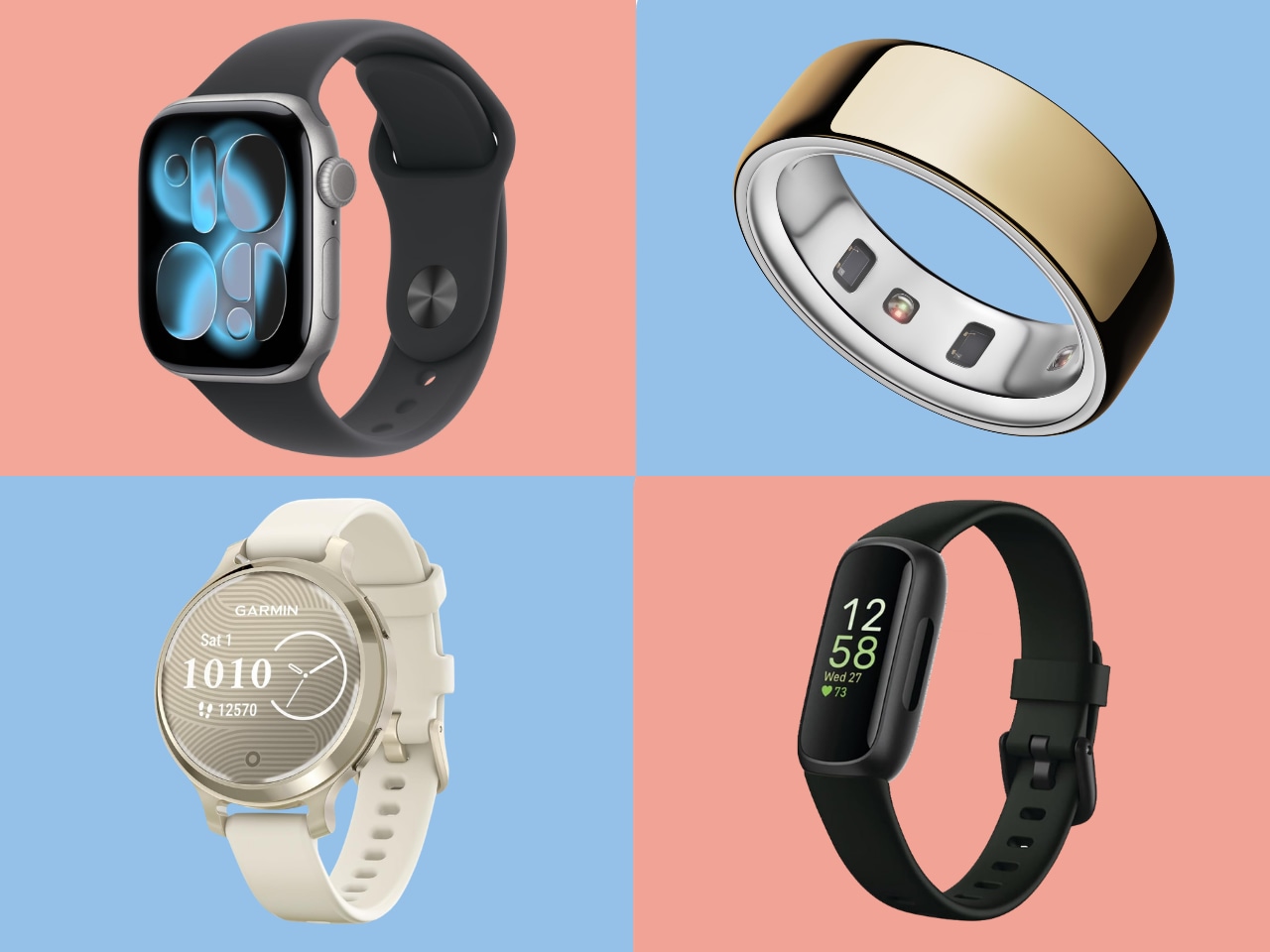
To say that wearable fitness trackers are having a moment would be an understatement. After all, doesn’t it seem like everyone you know has one? If it’s not an Apple Watch, it’s an Oura Ring. If it’s not a Garmin, it’s a Fitbit.
If you’re one of the few who doesn’t have one (or is looking to switch to a new one), having so many options can be overwhelming. That’s why we’re here.
To help make your decision easier, we compiled the facts about four of the top fitness wearables (and our personal experiences with the devices) in this quick guide.
What is a wearable fitness tracker?
A wearable fitness tracker is a device worn on the body — typically on the wrist — that monitors physical activity and health metrics. As technology has advanced and the demand for fitness trackers has grown, ring fitness trackers have also become increasingly popular.
Fitness tracker users like to use these devices to track their workout activities, like running, swimming and biking. However, most wearable fitness trackers can do so much more than count steps and calories burned.
In fact, Harvard Health published an article in 2025 that stated wearable fitness trackers can “help you stay safe if you have heart disease.”
The article included commentary from Dr. Sawalla Guseh, director of the Cardiovascular Performance Program at Harvard-affiliated Massachusetts General Hospital. Dr. Guseh offered an example of how wearable fitness trackers can help detect heart disease, stating, “I had one patient who didn’t feel chest pain or related symptoms, but he noticed his exercise performance declining over time. It turned out he had coronary artery disease.”
Further advancements in fitness trackers have also introduced features like sleep health tracking, menstrual cycle tracking, recovery metrics and hypertension detection. These additions underscore just how valuable consumers are finding these devices in their everyday health routines.
Now while there are many fitness trackers on the market, there are four that we would consider giants of the category: Apple Watch, Oura Ring, Garmin and Fitbit. So, how do they compare and which one is right for you?
Apple Watch — Best for health and fitness fanatics
Hiya, it’s Sarah (the shopping team’s Associate Commerce Editor), and for close to four years, my Apple Watch and I were inseparable.
As someone with chronic health issues looking to stay on top of things, the Apple Watch’s robust health and fitness monitoring has everything a health-conscious individual could ask for.
First and foremost, the Apple Watch’s fitness offerings are hard to beat. The integrated workout app offers settings for almost every activity you can think of, from walking and running to swimming and yoga. While tracking these activities, it also collects helpful metrics to help you push harder and train smarter during workouts.
Now, let’s talk about health. The Apple Watch 11 offers some of the most advanced health monitoring around. This includes sleep tracking (which also includes sleep apnea alerts), an ECG function to check for possible AFib, heart rate monitoring, menstrual cycle tracking, blood oxygen readings and hypertension alerts.
The Apple Watch also takes every aspect of health into account with safety features like fall detection, crash detection and access to emergency SOS services, all from your wrist.
This latest model also offers 5G connectivity (with a cellular plan), allowing you to call, text, use Apple Pay, stream music and more, even when your iPhone isn’t close by.
When all is said and done, I’d call the Apple Watch the do-it-all fitness tracker, making it easy to see why it’s as revered as it is. However, it is no longer my go-to fitness tracker of choice…
Oura Ring — Best for sleep tracking
Hey, it’s Sarah again! So, after a few years with my Apple Watch, something happened that I never thought would — I began to hate it.
The reason? I started to become obsessed with tracking my health, so much so that it was giving me anxiety. My doctor likes to call it “Apple Watch syndrome.” Yikes.
Not only was I anxious when I didn’t hit my targeted steps or calories burned for the day, but I found myself constantly monitoring my heart rate and obsessing over sleep metrics, something that only contributed to the decline of both.
All said, I still wanted to get insights into my health, but in a less “in-your-face” way. That’s when I picked up the Oura ring and never looked back.
First and foremost, the Oura ring is different in one major way: no screen. This was actually the initial thing that drew me to Oura. The idea of tracking my health on my own terms (through an app on my phone and not by yet another screen in my life) felt like a godsend.
It’s also a ring, and a pretty one at that. Look, the Apple Watch and other wrist-based fitness trackers aren’t ugly, per se, but I think we can all agree a shiny gold ring goes much better with a dress on date night than a clunky Apple Watch does.
Now for the important part: the health tracking. If you’re looking to record advanced fitness data, this isn’t the tracker for you. However, if you’re looking for superior sleep, readiness and stress tracking (as well as your general heart rate monitoring, basic fitness tracking and menstrual cycle insights), this is the one for you.
My favorite feature? The Symptom Radar. It uses biometric trends like temperature, respiratory rate, resting heart rate and HRV to help you stay on top of impending illnesses or the start of a cycle. I cannot tell you how many times I’ve gotten the “major signs” detected alert, only to come down with something in the next day or two — this alone makes the monthly subscription fee worth it to me.
In the end, the Oura ring helps me keep an eye on everything I want to in a way that doesn’t stress me out (or cramp my style) and that’s why when it comes to fitness trackers, I’ll always be team Oura.
Garmin — Best for runners
Hi, it’s Ana (the Shopping & Deals Senior Manager) and I am a fitness-obsessed girl to my core. I spent months toward the end of 2025 debating between a Fitbit and an Apple Watch. When I asked our TikTok followers for recommendations, they told me to forget both of those brands and get a Garmin.
So, I got the Garmin Lily Active , and after nearly using it for three months straight, I get the hype.
The Lily Active is essentially triple the cost of my old Fitbit device, but this device has more smartphone options and run tracking that the Fitbit simply does not offer.
I like that in the Garmin app, I get personal best alerts when I get a new PR on a mile, 5K or longest run. The Garmin app shows all my previous personal bests in one place, so I can easily see my progression without having to dig through the app to find my last PR.
You can also train for races using the Garmin Coach training plans from expert coaches available in the subscription. But if you don’t want to pay for anything extra, you can create your own workout. I created one for running that maps out running and walking intervals, two minutes running, one minute of walking, etc. There are also tons of free workouts in the app that you can use at any time like “30-Minute Blast” and “15-Minute Ab Burner.”
I got the device because people online recommended it as best for step counting and sleep tracking, and I highly agree. Not only does it sleep track, it also gives me alerts when I need to get more rest with suggested sleep durations and it lets me know when I’ve had a high-stress day or a relaxing day. Not enough relaxing days, as of late, but the Garmin keeps encouraging me to find some balance between rest and exercise.
Fitbit — Best for step counters
Ana, again! I was a Fitbit girl for almost 12 years, so I know a thing or two about Fitbit devices. I had at least five different models over the course of a decade and the last model I had was one that I really loved: the Fitbit Inspire 3.
I recently got a new Fitbit for Christmas (the Charge 6) and absolutely hated it. It was too bulky and sat very weirdly on my arm. So, I switched to the Garmin mentioned previously. But if I really wanted to stick with Fitbit, I should have gotten a new Inspire 3, because it is sleeker and looks better than the Charge 6. However, the Inspire 3 has so few color options or designs that the switch to Garmin made more sense for my needs.
If you’re looking for a simple step counter that has a great smartphone app, Fitbit is for you. You can see your steps for each day, or from 10 years ago, in the Fitbit app. This is really great for people who love to have a historical look at the step data. It accurately tracks steps, but the Inspire 3 also tracks:
Sleep duration
Active zone minutes
Exercise days
Calories/energy burned
Hourly activity
You can use the Fitbit app to track nutrition (food and water), log health metrics like menstrual health, weight, stress management and more.
Final Thoughts — Which one is right for you
At the end of the day, the right wearable comes down to your personal needs.
Choose an Apple Watch: If you want a well-rounded fitness tracker with some of the most advanced health tracking in the game.
Choose an Oura Ring: If you want a wearable that focuses more on sleep and general health over fitness (and a stylish, screenless design)
Choose a Garmin: If you want a great fitness companion, especially for runners.
Choose a Fibit: If you want a simple and affordable way to keep an eye on essential health metrics.
When it comes to us, we lean team Oura and team Garmin. But who knows, with the way the wearable market is booming, there just might be another device that comes in to steal the crown. For now, these four are truly some of the best of the best.
Which wearable fitness tracker is right for you? Apple, Oura, Garmin or Fitbit