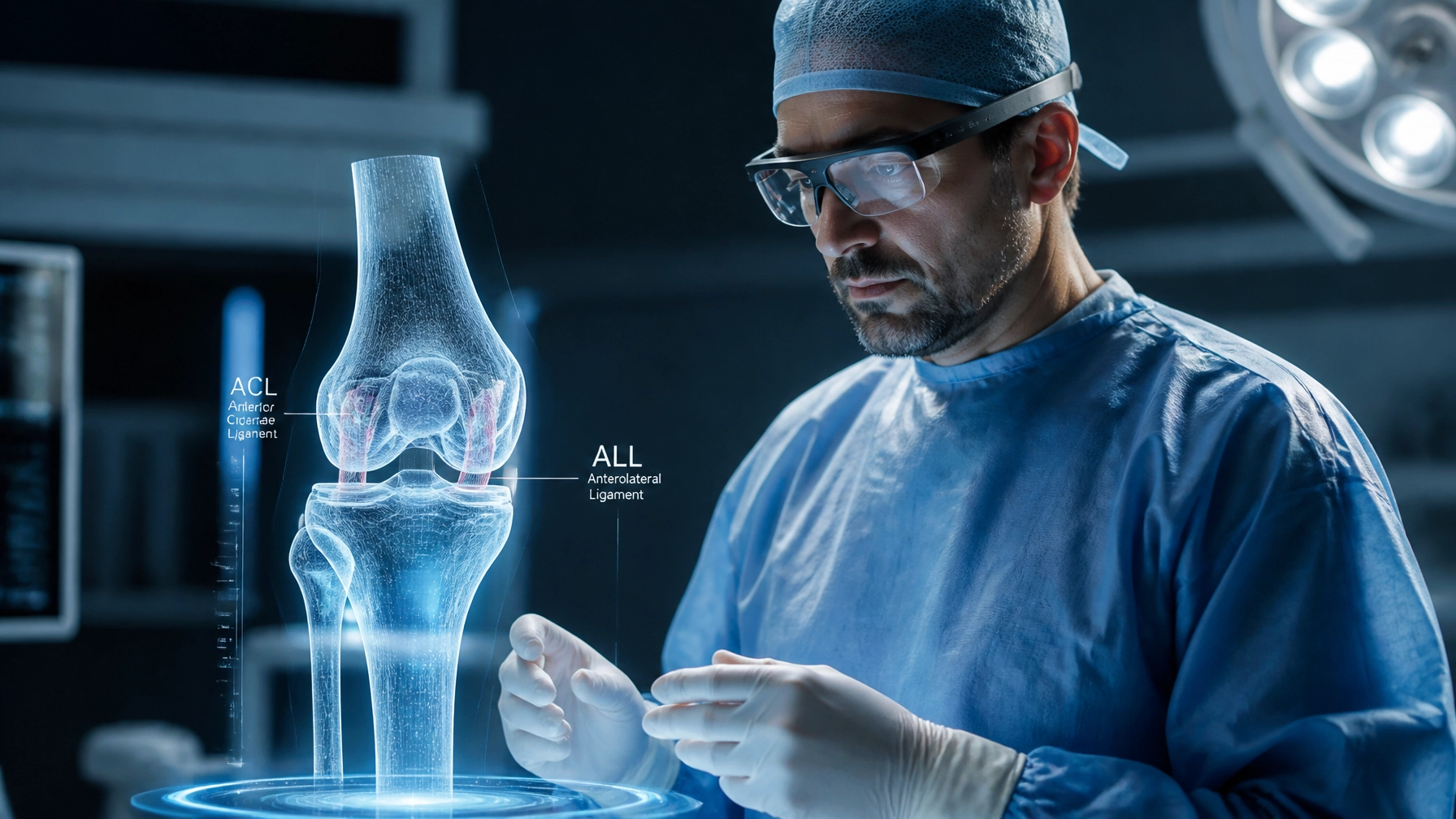
DENVER, July 20, 2026 : The landscape of sports medicine and injury rehabilitation has shifted following new clinical data revealing that the integration of Anterolateral Ligament Reconstruction (ALLR) with primary Anterior Cruciate Ligament Reconstruction (ACLR) reduces graft failure rates from 11.37% to 2.58%. This finding, published in Knee Surgery & Related Research in June 2026, marks a definitive shift in surgical protocols for high-demand athletes, particularly those in pivoting sports like soccer and basketball.
For decades, the standard isolated ACLR was plagued by residual rotatory instability and high re-injury rates in young populations. The June 2026 evidence confirms that augmenting a primary hamstring autograft with ALLR provides the lateral stability necessary to protect the primary graft during the critical phases of return-to-sport. This advancement in sports medicine is now being hailed as the "2026 Standard," offering a biological and mechanical solution to a problem that has sidelined thousands of professional careers.
The Surgical Shift: Why ALLR is Non-Negotiable for High-Risk Athletes
The recent meta-analysis from June 2026 underscores a brutal reality: isolated ACL reconstructions often fail to address the complex rotatory forces exerted on the knee during high-speed change-of-direction. By adding the ALLR procedure, surgeons are effectively "reinforcing" the knee’s secondary stabilizer. The data indicates an 82% reduction in high-grade pivot shifts, ensuring that the tibia remains properly aligned during explosive movements.
"We are no longer just replacing a ligament; we are reconstructing the entire functional anatomy of the knee," says the lead researcher in the Knee Surgery & Related Research report. This shift is particularly critical for soccer players, where the combination of sudden deceleration and lateral cutting creates a "perfect storm" for ACL failure. The reduction in re-tear rates to a mere 2.58% suggests that the "biological failure" often blamed on poor healing may actually be a mechanical failure of the isolated reconstruction.
Early-Stage Rehabilitation: Beyond Passive Motion

While surgical techniques have advanced, the immediate post-operative phase remains a bottleneck in injury rehabilitation. On July 15, 2026, a study published in Frontiers demonstrated that Functional Proprioceptive Stimulation (FPS) combined with Continuous Passive Motion (CPM) significantly improves early Range of Motion (ROM) compared to CPM alone.
For medical practitioners, this indicates that the "brain-to-knee" connection must be addressed within days of surgery. FPS uses low-frequency vibration and electrical cues to "trick" the nervous system into recognizing joint position, preventing the muscle inhibition that often leads to chronic quadriceps atrophy. In a field where the first six weeks dictate the next six months, the integration of FPS into standard CPM protocols represents a major leap in early-stage recovery.
Athletes who utilize these concurrent modalities show a faster return to baseline mobility, allowing them to progress to weight-bearing exercises sooner. This is essential for maintaining the metabolic health of the joint and preventing the "stiff knee" syndrome that often complicates late-stage rehab.
Strength Training: The Engine of Soccer Performance

In the realm of athletic performance, the debate over "soccer-specific" training versus traditional lifting was settled in July 2026. Research in Frontiers in Physiology identified strength training as the single most effective intervention for enhancing soccer performance and resilience.
Following an ACLR, the focus of injury rehabilitation must transition from "healing" to "loading." The July 2026 data shows that athletes who prioritize heavy resistance training: specifically targeting the posterior chain and quadriceps: outperform those who focus solely on agility and cardio. Strength is the foundation upon which speed and power are built. Without a robust muscular "shield," even the most perfectly reconstructed ACL is at risk.
For practitioners at Sports Medical News, the message is clear: the gym is where the game is won. Athletes are encouraged to utilize resources like our 10 nutrition tips for 2026 to fuel the hypertrophy required to regain pre-injury power levels. Proper protein intake, potentially through accessible sources like peanut butter, remains a cornerstone of this metabolic recovery.
High-Tech Recovery: Pneumatic Cold Compression

Recovery is no longer a passive act of "resting." A June 2026 report in the Journal of Sports Science and Medicine (JSSM) highlights the efficacy of Pneumatic Cold Compression (PCC) in accelerating the return of Maximal Voluntary Contraction (MVC). Specifically, using a protocol of 3°C at 75 mmHg post-hamstring fatigue was found to significantly reduce the recovery window.
This technology bridges the gap between professional training rooms and home-based injury rehabilitation. By combining cryotherapy (cold) with intermittent pneumatic compression (pressure), PCC flushes metabolic waste from the tissue while simultaneously reducing inflammatory edema. For the post-ACLR athlete, this means less time spent "recovering" from the rehab session and more time spent "training" in it. The ability to return to maximal contraction sooner allows for higher training frequency, a critical factor in the race against muscle atrophy.
Youth Sports: The Power of Proactive Neuromuscular Training

Prevention remains the most effective form of sports medicine. On July 2, 2026, Frontiers in Sports and Active Living published findings on Neuromuscular Training (NMT) warm-ups in youth soccer. The study concluded that structured warm-ups: focusing on balance, landing mechanics, and core stability: drastically reduce ankle and ligament injuries.
However, there is a catch: the effectiveness of these programs is entirely dependent on adherence. The research found that teams that implemented NMT at least twice a week saw a 45% reduction in non-contact ACL injuries, while teams with low adherence saw negligible benefits. This emphasizes the role of coaches and parents in the "pre-habilitation" process. As we integrate AI-driven health tools to track player movement and fatigue, the ability to mandate these warm-ups becomes a data-driven necessity rather than a suggestion.
The 2026 Protocol: A Unified Front
The recovery of an ACL injury in 2026 is no longer a fragmented journey. It is a unified protocol that begins with a superior surgical technique (ACLR + ALLR), progresses through high-tech early mobilization (FPS + CPM), and culminates in high-intensity strength training supported by pneumatic recovery tools.
Medical practitioners must now move toward this multidisciplinary approach. The data is definitive: the "isolated" approach is a thing of the past. To keep athletes on the pitch and out of the operating room, the integration of these June and July 2026 findings is the only path forward.
Summary of New Standards (2026)
- Surgical: ALLR augmentation is now recommended for primary hamstring autografts to reduce re-tears by ~77%.
- Early Rehab: FPS combined with CPM is the new gold standard for early ROM gains.
- Performance: Heavy strength training is prioritized over sport-specific agility in the early-to-mid phases.
- Recovery: Pneumatic cold compression (3°C, 75 mmHg) is the verified protocol for MVC restoration.
- Youth: NMT warm-ups are mandatory for injury reduction, with success tied directly to weekly adherence.
For more updates on breaking medical news and healthcare policy, subscribe to the Sports Daily Newsletter.